This article originally appeared in “Seniority” (Autumn 2024) — Age Concern Wellington Region
One way of staying connected as you gain in age and experience is to join one of the many social clubs established to exercise the mind and soul. The main ones are Probus, Rebus, Friendship Clubs, U3A, and probably many more. Each of them has monthly or even more frequent meetings and annual membership fees are relatively modest.
There is more to these clubs than meets the eye. At first sight, they would just seem to be an excuse for people to get together once a month and listen to some noble person warble on about their area of expertise, which may, or may not, generate some questions from the audience. And there may be a cup of tea and a bit of a chin-wag afterwards. That was my impression when asked to join the newly formed local Probus Club a few years ago.
Wikipedia describes Probus as “a local, national, and international association of retired people who come together in non-political, non-sectarian, non-profit, autonomous clubs which provide regular opportunities for members to meet others in similar circumstances, with similar levels of interest, make new friends, and maintain and expand their interests.
One feature of the Clubs is to have a member of the Club give a five-minute talk about themselves or a topic of interest to them, which is also a means of getting to know some of them. In our club we have heard about travels in the Arctic, construction and flying model planes, collection of first edition LP records, books written, as well as brief autobiographies and/or family histories. Everyone has an interesting story to tell, if only you can get them to stand up in front of the crowd. There is one rule which requires people to avoid speaking about politics or religion. One speaker talked about the American elections and was criticised for raising political issues as there was some support for each of the parties and their presidential candidates.
But that is just the beginning of the story. Once we got under way the club started expanding its membership and its range of activities beginning with the usual book group, which met monthly and then a weekly walking group. Very soon it was all on. We had monthly Dinner, Lunch, Cinema, Circa, Day Trips and, Social Issues groups, plus weekly Petanque, Coffee/Tea and Happy Hour groups. The range extended with out-of-town group travel to various parts of the country.
At the peak, we had 160 members and all these activities meant that in one way or another, we were thrown together and got to know each other and their likes, dislikes, fancies, and foibles. So, it was not just monthly meetings.
As the editor of the Wellington Central Probus Club newsletter, I joined with other Probus Club editors in the Wellington region to exchange newsletters and other information. We also decided that Rebus and Friendship clubs should be included in the exchanges. There are about 20 such organisations in the greater Wellington region. That is when we found that the range of interests and activities covers just about anything you can imagine. There are groups with an interest in wine appreciation, cooking/baking for men, digital technology, gardening, travel, Cryptic crosswords, and even Quiddler (whatever that is).
If that is not enough there is U3A or University of the Third Age which Wikipedia describes as “an international movement whose aims are the education and stimulation of mainly retired members of the community — those in their third ‘age’ of life. There is no universally accepted model for the U3A. Its original conception in France as an extramural university activity was significantly modified in the United Kingdom where it was recognised that most people of retirement age have something to contribute and the emphasis has been on sharing, without formal educational links.”
Checking the interest groups on the U3A Wellington site (https://u3awellingtoncity.org.nz/study-groups/) opens up another level of interests for older people to choose from. In addition to some similar to those above, they include Health, Music Appreciation, Philosophy, Shakespeare Studies, and German and Te Reo conversation groups.
The essence of all these groups is the opportunity they provide to get together with others who have similar interests. But when any group of older, wiser people get together to discuss a particular subject, they will invariably extend their discussions beyond the chosen topic. It is the same with any gathering for physical activity: our petanque group meets twice a week to play sometimes fiercely competitive games, but that is just the perfect excuse to go to the local pub to sort out the woes of the world. One thing leads to another. So, joining one of these organisations is worth considering if you have time on your hands.
Originally published in “Seniority” magazine –Age Concern Wellington Region
Volunteering is generally viewed as a service that helps people and changes their lives, but the Mayo Clinic recently advised that it can also benefit the health of the volunteer. A volunteer doesn’t have to be a wealthy donor or a politician to make a difference in their community, they can enhance people’s lives purely by volunteering their services, big or small, to assist others in your community. Research has shown that voluntary service can provide significant health benefits for the volunteer, particularly for older adults.
There is some contention about whether volunteering makes people happier, or that there is a reverse causality in that happier people are more likely to volunteer. Be that as it may, the general view is that volunteering can improve both the physical and mental well-being of the volunteer.
One study published in 2020 by the Journal of Happiness Studies reported that people who volunteered reported greater life satisfaction and better overall health as opposed to those who didn’t. In addition, they found that those who volunteered more frequently (at least once a month) showed better mental health than those who volunteered less frequently.
The Harvard Medical School has been looking at these mental and physical health impacts including the question of how volunteering might contribute to lower blood pressure and whether it may also reduce stress.
A study conducted by Carnegie Mellon University comments, “As with any activity thought to improve health, researchers are trying to identify the specific characteristics of volunteering that provide the greatest benefit. For example, how much time would you need to put into volunteer work to lower your blood pressure or live longer?” Their study proposes that 200 hours of volunteering per year correlated to lower blood pressure. But there are other studies that have found a health benefit from as little as 100 hours of volunteering a year.
Which types of volunteer activities improve health the most? No one really knows. There is some speculation that mentally stimulating activities, like tutoring or reading, might be helpful for maintaining memory and thinking skills, while “activities that promote physical activity would be helpful with respect to cardiovascular health, but no studies have really explored this.” So, it is all a bit up in the air, but speculation is rife, and theories persist.
The general view of the health benefits to the participants of volunteering to help seniors comes down to:
Increased physical activity. Many volunteer opportunities involve physical activity to a greater or lesser extent, such as taking seniors for walks, or even visiting them. Any regular activity can help improve physical health and reduce the risk of chronic diseases.
Reduced stress. It is suggested that volunteering can help to reduce stress by providing a sense of purpose, action, and achievement. The volunteer connects with others and builds relationships, and shares experiences and opinions, which can further reduce stress.
Improved mental health. Volunteering gets people out making contacts, either individually or in groups, to develop a broader social network which helps improve mental health by reducing isolation and loneliness. It can also help to boost self-esteem and confidence.
Sense of purpose. Volunteering can give you a sense of purpose and make you feel like you are making a difference in the world. This can boost your self-esteem and overall well-being.
Longer lifespan.Volunteering has been linked with helping individuals live longer. This is possibly due to the benefits listed above of reduced stress and better social connections.
Lower blood pressure.Volunteering may help reduce blood pressure, perhaps by increasing physical activity and lowering stress. That’s important because high blood pressure is a risk factor for heart disease and stroke.
While the science may be a little vague, it generally points to the conclusion that if you want to improve your health and well-being, volunteering to help seniors is a great option.
Age Concern has options for volunteering to assist seniors in the wider Wellington region. There is a volunteer opportunity that is right for you. So, if you feel so inclined give us a call. You will be glad you did.
Looking back on aspects of a life spent reasonably well, there are some activities that seemed crazy at the time but had long-term effects. One of those activities I indulged in while attending Lincoln Agricultural College was a “capping stunt” in 1961 pushing a hospital bed (with original Bakelite casters) around Hagley Park in Christchurch to set a new record.
Massey University had claimed a record of 57 miles, and the newspaper report carried the challenge, “Let other universities try and beat that.”
A team of ten were hastily cobbled together and camped in Rolleston House to start the marathon at 1.00 pm on a Saturday; allowance had to be made for some who were involved in rugby games that afternoon. Teams of two, wearing calico smocks to improve visibility, took between 45 and 50 minutes to complete the measured circuit and finished with a total of 65 laps, or 203.5 miles (327.5 km). Cracked it.
Capping events in those days were part of a student fundraising scheme for a chosen charity and that year the charity was Cholmondeley Homes for Children. Unfortunately, there is no record of the funds collected.
That is the background to friendships that developed amongst a relatively diverse group of students from all parts of NZ plus a Scotsman and an Aussie, which has lasted over 60 years.
We basked in our glory for a few weeks and then got on with the more serious business of passing exams which was also accomplished by all members of the team. But after twenty years a call went out for a reunion to celebrate our achievements. It took a year to get it together, especially as the venue suggested was Hawaii, but seven of the team and partners made the grade. Hat set the scene for regular reunions over the years with the ninth one being held in Christchurch and Lincoln University this year.
We have cycled down from the top of a volcano in Hawaii to have breakfast on the beach, played golf at numerous courses, gone fishing on Lake Taupo, been to a Menzshed in Bright (Victoria), visited farms, gardens (including a tea garden) and many restaurants, all the while chatting and recalling events that had almost faded from memory over the years. There has been a bit of eating and drinking and a hell of a lot of fun.
During the last two reunions, the emphasis has been on the value of the connections we made during our years at university and particularly the way in which that diverse group of students still manage to hang together and get along so well. While we meet as the “Bedpushers” we maintain contact each other and over the years have tapped into their different areas of expertise to assist with our own projects.
As might be expected our numbers have dwindled over the years but because the contacts are so strong the bereaved partners have always been included in the mix.
The value of the relationships has been extended in the last few years to include some non Bedpushers and their partners which means that the reminiscences extend well beyond the original capping stunt.
So while some reunions can be a bit of a trial of strength and endurance where you try to remember the names of those from the past, a reunion that focusses on a special activity or function has a lot more going for it, and builds those strong relationships that keep you going and going.
A poem/ditty I composed for one of the reunions captures the essence of fun and friendship that has stayed with us over the years.
One of the issues facing older people these days is the tendency for families to be widely dispersed. Recently, a client of Age Concern noted that her two daughters lived overseas, and her son was disabled and could not go anywhere easily. Since her husband died, she had been living at home, on her own, for over 25 years — but she still managed to maintain her social connections.
In addition to her cleaner and gardener, and regular visits from the District Nurse, she had a companion who took her shopping, another for going to the movies and outings, and a weekly visit from an accredited visitor from Age Concern. It just took a bit of organising, but she knew that it was for the better.
It is well recognised that there are considerable benefits in the development and maintenance of social connections no matter what your age. This becomes more important as you grow older and people pass away or move away, or there are changes in personal health and ability, different living arrangements, and other factors, all of which increase social distancing to the detriment of mental health and well-being.
A study at Stanford University in 2014 found that “strong social connection:
leads to a 50% increased chance of longevity
strengthens your immune system
helps you recover from disease faster, and
may even lengthen your life!
“People who feel more connected to others have lower levels of anxiety and depression. Moreover, studies show they also have higher self-esteem, greater empathy for others, are more trusting and cooperative and, as a consequence, others are more open to trusting and cooperating with them. In other words, social connectedness generates a positive feedback loop of social, emotional, and physical well-being.”
Any move to help the elderly stay connected with their community and family can benefit their mental health and well-being and could help them maintain their independence and mobility. Group activities can keep your brain vitalised.
So, if you are in that older cohort, what can you do about improving your social connections? As indicated above, social connections usually don’t come to you – you must make a bit of an effort.
Here are some techniques or tips to create more social connections and build a whole new network of friends and colleagues.
Join community activities: you may already belong to an interest group like a gardening club, but there is no harm in widening that network. Think about U3A, or your local Probus/Friendship/Rebus club – all have a wide range of activities for people in the older age group.
Volunteer: not only will it help your community, it will also provide opportunities to meet new friends and develop new interests. Several organisations (including Age Concern) provide visitor services, matching volunteers with those who appreciate their company.
Take a class: if you have the urge to learn there are numerous adult and community education courses available throughout the Wellington Region, so you could train your mind and meet new colleagues. If that seems too arduous you could always just join a craft group and learn to draw, or cook or just sit around knitting or crocheting together. Of course, if such a group does not exist in your area you could always start one of your own and spread the word either online or on your community noticeboard.
Join an exercise group: Strength and balance groups for older people operate all over the Wellington region. Age Concern runs numerous Steady As You Go classes where you can improve your core strength and balance and find like-minded friends. See the schedule on the back page of this issue.
Join a Walking Group: there are groups which allow for different levels of fitness, so you don’t need to worry about dragging the chain, and sometimes you need to stop and smell the roses. Check out some of the Wellington walking groups here https://www.livingstreets.org.nz/node/1950. Alternatively, you could take up walking with a group of friends. But if you need some assistance walking, Age Concern Wellington Region has trained volunteer walking companions are keen to support you.
This is just a short list of the possibilities for increasing your social connections that exist in and around Wellington. It is really a matter of taking the time and making a bit of an effort, but there are some amazing ways to meet other people and establish strong and interesting friendships. Socialising is good for you.
It came as a bit of a shock to me recently to realise I had been volunteering in the Age Concern Wellington Region office for more than 18 months. While I had other projects on the go at the time, I noted that the time spent volunteering had been very satisfying. This led to the conclusion that there are benefits for the volunteer as well as for the recipients from this volunteering lark.
In essence, it could be that humans are social beings so that developing and maintaining social contacts is virtually ingrained in our makeup.
If you consult Google, you can find numerous articles listing the benefits of volunteering, and this appears to be more pertinent for older people who may have time on their hands once they retired from the daily grind.
One article described the five benefits for older people to be gained from volunteering which seemed like a useful list, but probably not the complete picture.
Confidence: Volunteering can be a means of gaining confidence as you take on slightly different tasks and deal with issues in different circumstances, which can give you a real sense of achievement. It also gives you a sense of purpose especially if you have a set time to look forward to each week.
Learn new skills: The office work at ACWR is not too different from my previous office experiences, but the topics I deal with and write about have been completely different, so I have expanded my knowledge base and taken on tasks that I would not have even thought of before.
Meeting New People: Although the ACWR office is small in terms of staff numbers, not all of whom attend every day as they are out and about, but they all come from different backgrounds and have their own tales to tell which adds to the interest in attending the office.
Being Part of the Community: There is any number of visitors and workers in adjacent offices to add to a developing circle of friends. It can also give you a feeling of purpose and can help you feel recharged with a new zest for life. Some pundits also suggest that it can also be a motivating factor for setting and accomplishing other goals.
Learning new skills: Many volunteering activities allow you to try things you’ve never done before and learn new skills and challenges that are a little outside of your comfort zone. You may develop a passion you never knew you had! I can certainly vouch for that as I have been introduced to new database management tools, interviewed a range of people and written articles on topics way outside my previous experience.
Mental Health: According to the National Institute on Aging, volunteering keeps the brain active, contributing to mental health. In their view, meaningful and productive activities can help you feel happier and have a positive outlook on life.
Other advantages are that volunteering prevents loneliness and isolation, it increases physical activity, it bridges the generation gap, it helps you engage with old interests, and it helps you learn new skills. Some articles make volunteering sound like a wonder drug for older people.
From my experience working as an Office Support volunteer at ACWR, there are quite a few more than those listed above. I get some exercise walking to and from the office, I find myself doing ACWR tasks and thinking about various aspects of the work in my spare time at home, and most of all it is great fun. Give it a go – you may find a new lease of life!
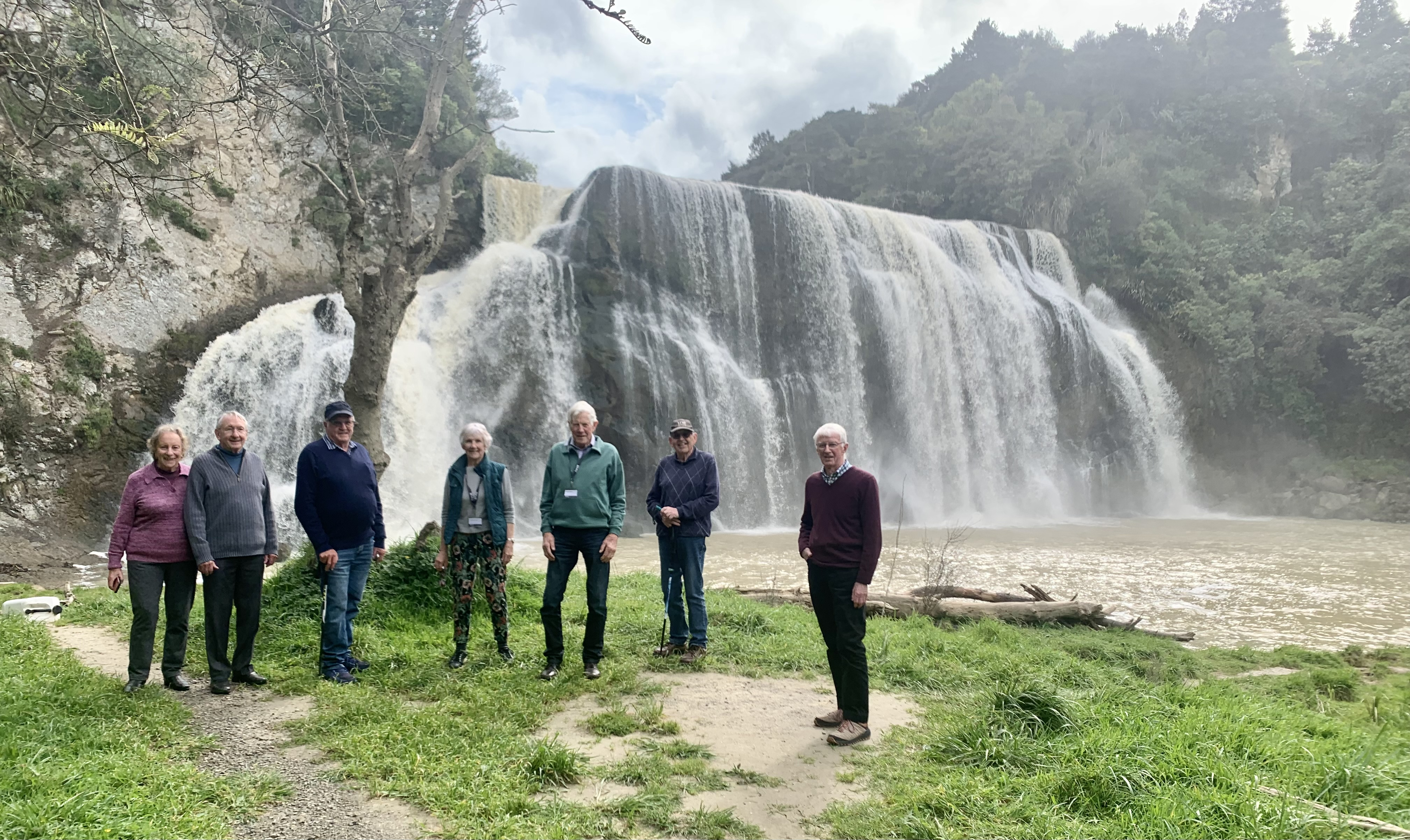
The Probus Wellington Central Tour Group at Waihi Falls
Wairarapa translates as “glistening waters”, which Māori legend/history advises can be explained in one of two, or maybe three ways. It is either the description of the sun shining on what is now lake Wairarapa as seen by a Haunui (the great-grandson of Kupe) when he reached the top of the Remutuka hills, or it is that the scenery he saw brought tears to his eyes as he scanned the new territory Or the tears were caused by his wife leaving him for a younger warrior. Lake Wairarapa is Ngā Whatu o te Ika a Māui (the eye of the fish of Māui).
The South Wairarapa coastline features some of New Zealand’s oldest inhabited sites, and local tradition states that the explorer Kupe lived there for a period. The southernmost point of the North Island, Cape Palliser, is known to Māori as Matitaki a Kupe, and other points along the coast also commemorate Polynesia’s most famed explorer. South Wairarapa District Council history
There are suggestions that the southern Wairarapa was first settled as a small Maori community from Palliser Bay moved north, due to an increasing population and diminishing food supplies of fish, shellfish, small birds and kumara. The main Māori tribal movements by Rangitane and then Ngati Kahungunu in the 1600s came in from the north.
Day 1. Wellington to Masterton
Whatever the story, “glistening waters” aptly applied to our departure from Wellington as rain accompanied us to the top of the Remutuka hill. Our Tranzit coach driver and tour guide was none other than Les Cockeram who led us on the memorable 13-hour ferry ride to start our Molesworth trip two years ago. An omen?
As luck would have it the sun shone while our party of 20 sat indoors and feasted on a sumptuous lunch at the Royal Hotel in Featherston, hosted by Theo Wisjmans and his crew. Unfortunately, the glistening waters returned as we arrived in Greytown for self-guided walks around the town centre. We had been warned that the shopping experience would probably not attract much interest from 50% of the group, but some retailers did provide seating for the men as they waited, but many of the shops close on Mondays so the shoppers had little to choose from. The fact that today was the anniversary of NZ women’s suffrage did not cut it with the retailers of Greytown.
Greytown is said to be the oldest town in the Wairarapa and the first planned inland town, with New Zealand’s most complete main street of wooden Victorian buildings. (Masterton was the second planned inland town). The idea was that the residents would have a house and section in town and travel to their allocated 40 acres of farmland each day. Unfortunately many chose to live on their farms so town sections were abandoned.
NZ history online records that, “Greytown was founded in 1854 by the Small Farms Association, which aimed to settle working people in towns and on the land. It was New Zealand’s first planned inland town, although the first settlers were greeted by dense bush. Once this was cleared, the town developed as a market and servicing centre.
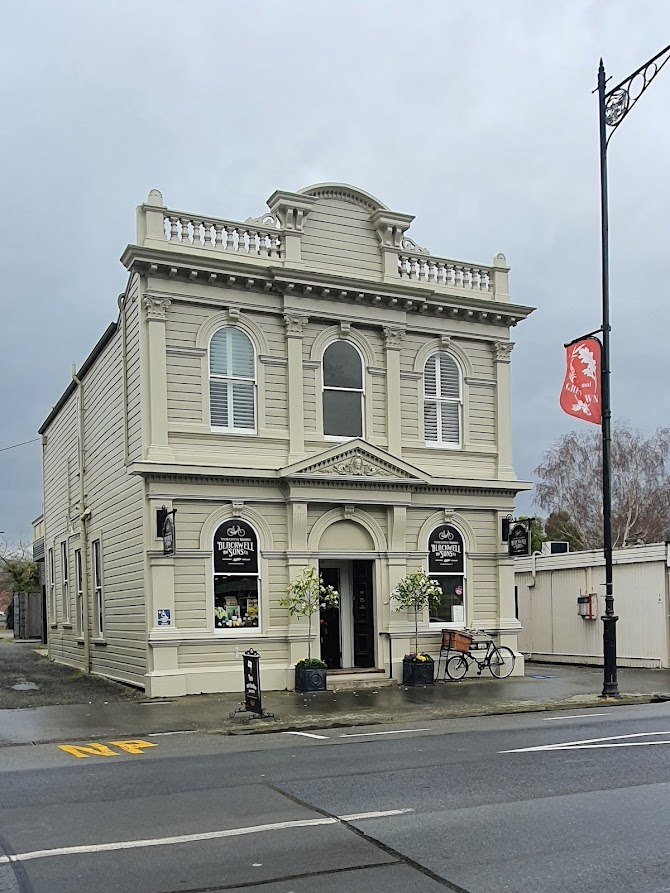
Blackwell and Sons bicycle shop – Greytown
We wandered around in the light rain, absorbing the views of old wooden buildings, many of which were designed and built to look as though they were stone constructions, not only those such as the banks, but also the building that housed Blackwell and Sons Bicycle shop, forerunner to a bookshop ’empire’ with shops labelled Mr Blackwell’s, or Mrs Blackwell’s, bookshop. True to form there were seats for the men, but some were outdoors and tended to be damp.
After a short road tour around the outskirts of Greytown the trip continued through the lengthy strip development called Carterton and on to the Copthorne Solway Park hotel in Masterton, our accommodation and base for the next few days.
Following what seemed to be an extremely short break of 90 minutes the wine and food tour continued with a visit to Farriers Restaurant and Bar for another meal with country-sized portions. It was almost too much, but we managed to stay awake long enough to watch the preliminaries for the funeral of Queen Elizabeth II. That was no mean feat for us oldies.
Day 2. Rathkeale, Tui Brewery, and Waihi Waterfall
The day started with a quick flick through the highlights (if you can call them that) of the funeral service for QE II, and ceremonial transfer of the coffin to Windsor. There were sufficient replays to get the general gist of the ceremony, but it’s likely that more will be on offer.
We breakfasted at the ungodly hour of 7.30 which meant we had more time to review the funeral before our departure at 9.30.
Les took us on a tour of the back streets of Masterton to learn about the plethora of educational facilities available to the students of the Masterton area. There are numerous schools catering to the different social standings of the parents, and some of these institutions have remarkably small numbers of students. This was the lead up to venturing on to the hallowed grounds of Rathkeale College north of Masterton, which we circumnavigated with commentary from Part Rutherford who used to be the college registrar.
Rathkeale College was established in 1963to complete the family of schools managed by the St Matthew’s Schools Trust Board, which already had a girls school in St Matthew’s Collegiate School and a preparatory school in Hadlow School. Source: Wikiwand
The more common commentary is that the school was established by the landed gentry of the Wairarapa to provide alternative educational facilities with a similar standard of education to that provided by Christ’s College or Wanganui Collegiate for their sons because demand exceeded supply at those renowned institutions. Both the original head and deputy headmasters came from Christ’s College. Nowadays, girls from senior classes at St Matthew’s in Masterton also attend. The buildings are set in immaculate tree-lined grounds in placid rural surroundings.
Our concern was whether the 335 pupils really appreciated their beautiful and peaceful setting, as well as the standard of education being provided.
Our tour of the hidden treasures of the Wairarapa continued north through Eketahuna, which is described as “a friendly rural town situated on the banks of the Makakahi River. Early pioneers originally named the town Mellemskov, which means “Heart of the Forest”. This name was eventually discarded in favour of ‘Eketahuna’, a Maori word which means to “run aground on a sandbank” (this name originated because Maori canoes could not paddle beyond this part of the Makakahi River).” Source: NZ History online
This quiet rural town’s main claim to fame, apart from being considered as the middle of nowhere, is that it is the home of the Tabu Adult Sex Shop.
The tour then became a beer, wine and food fest as we pressed on to the once bustling township of Mangatinoka, home of the famous Tui Brewery, which could not be classed as a hidden gem of the Wairarapa. Unfortunately, since being taken over by Heineken, almost all the beer is brewed in Auckland and the site is more of a monument to the glory days.
It celebrates its founder Henry Wagstaff, a failed cheese-maker and a bit of a philanderer, who stopped for a tea break on the banks of the Mangatainoka River and decided that while the water provided a fine cup of tea it would be better for brewing beer. The rest is history, helped along by the prominent tower (built without stairs to the top levels and the memorable Tui billboards. “I was just reading her T-shirt YEAH, RIGHT.”
Much against our better judgement we sampled the available beers, learned some of the history of Tui, dined on a BBQ lunch, and eventually departed, fully sated.
Heading east and north we entered hill country farming with a sprinkling of new season lambs plus the controversial development of extensive areas of farmland being sold to overseas investors and converted to pine forests for carbon credits. For some more traditional agriculturalists, it was a depressing sight. Some suggested that planting natives would be more acceptable, and we were reminded of the call for “the right tree in the right place”.
Several of the group members made it to the foot of the Waihi Falls.
We wound our way through the scenic Makuri (white dog) gorge and eventually reached the Waihi falls – a cascade of water that is wider than it is high. Access for a better view was down a track and a series of 110 steps, attempted by those who thought their muscles and joints were sturdy enough. It was worth the effort.
The sun shone so we all assembled for a group photo which turned out to be a long session as Les had to operate several smartphones to capture the scene for members of the group.
Suitably photographed we headed to the Pongaroa Hotel for a reviving ale suitably accompanied by a little snack of pizza and chips. Recent rains in the area had caused a slip on our chosen road home required backtracking on our route through the Makuri Gorge, thus it was not surprising that several of our group succumbed to a quiet snooze. They needed to re-energise for drinks and dinner at the hotel to round out the day – and their body forms.
Day 3. Brancepeth and Te Parae and the “Gladdy”
As a reward for fortitude, we were granted a leisurely start this morning, except that for some of us breakfast at 8.00 am still fails to qualify as a leisurely start. The predicted rain had bucketed down overnight but stayed away for our departure.
Les, our driver and fount of all knowledge, decided to further improve our understanding of local lore with another tiki tour taking in the Masterton QE II Botanical Gardens, lake, and associated sporting facilities along with the indoor stadium. He advised the council had planned a convention centre, but an ongoing debate about where it would be sited has delayed its progress.
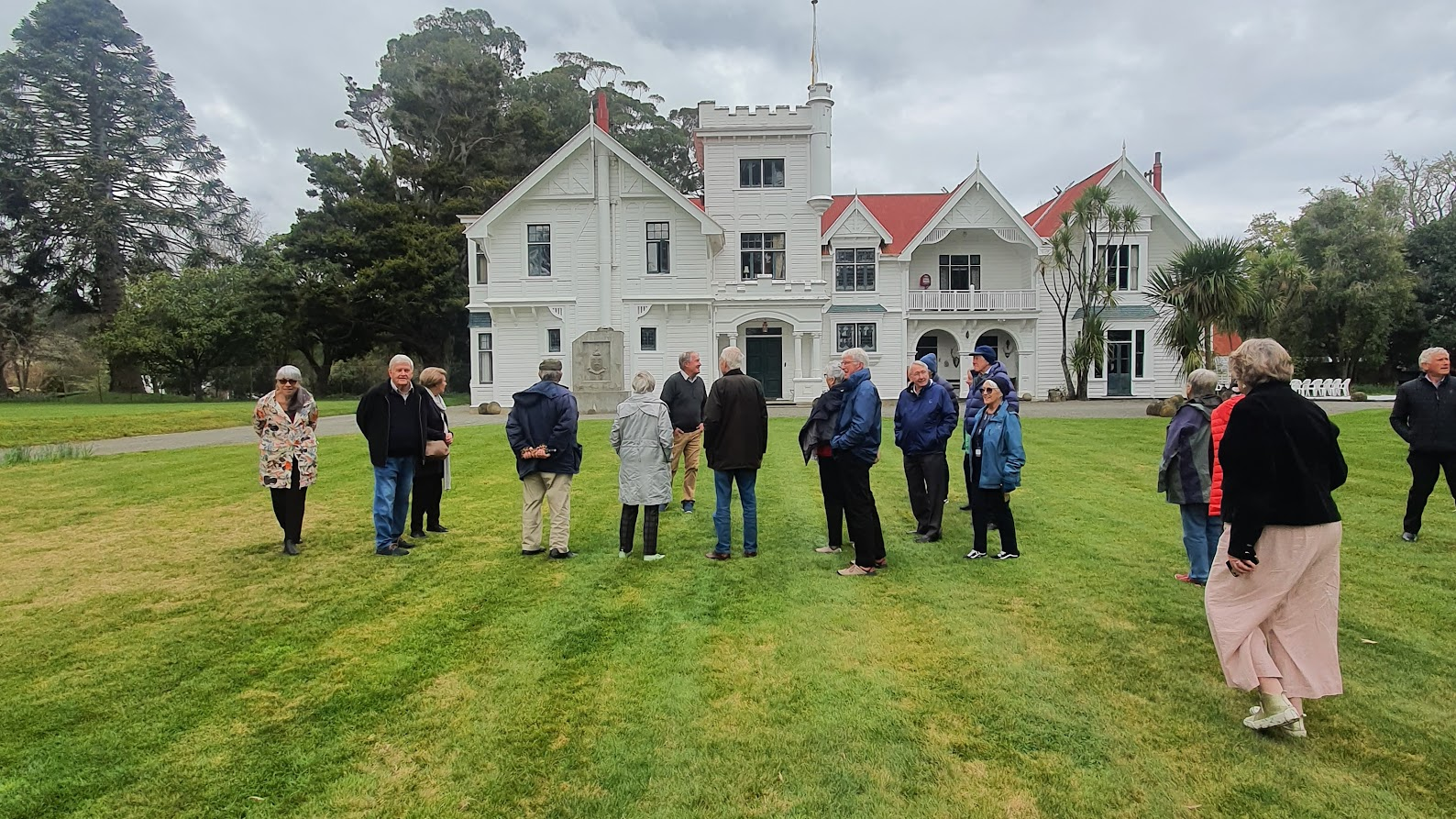
The object of today’s tour was to look and learn about the Beetham/Williams farming dynasty founded by the Beetham brothers, William, George, Charles and Richmond who, in 1856 took up a lease of 10,000 acres in the Wainuioru Valley 22 km east of Masterton. As a result of some hard work, a strategic marriage of daughter Ann Beetham to T C Williams of Te Parae (see below), and financial dealing they bought out the lease and expanded the united property to 70,000 acres running some 90,000 sheep plus cattle. The original 500 merino sheep suffered from foot-rot as well as the predations of feral dogs and pigs. The Beetham’s initial home was a whare or basic shed constructed in 1856 with pit sawn heart totara, then the original homestead was built in 1858, (still existing) before beginning a stately pile built in three stages from 1886 to 1905 et seq, complete with crenellated turret, lead-lined windows and 36 rooms. Shades of Little Britain perhaps.
Brancepeth Station homestead
The immediate surroundings were planted with a variety of imported trees including English and Irish Yew, Araucaria bidwillii — commonly known as the bunya pine and sometimes referred to as the false monkey puzzle tree, peppermint gum, western red cedar, Oregon pine and several oak species.
But that was not all; given the size of the enterprise and the staff needed to keep it going there were numerous outbuildings such as stables, a 24-stand woolshed built in 1859, an acetylene gas production shed for the gas lighting, cookhouse, single men’s quarters, schoolhouse and library for the workers built in 1884, managers offices etc, as well as accommodation and other facilities at outstations around the station property. So it was more of a community than just a family home.
We were treated to morning tea/coffee and scones while being regaled by Ed Beetham with the history of the station and the trials, tribulations and triumphs of its owners and occupants.
The local history lesson was continued by Tom Williams at what remains of the Te Parae station after the combined Brancepeth/Te Parae enterprises were split up into eight separate properties due to the graduated tax introduced in 1906 to limit the size of these farming dynasties. Nowadays the Williams family has two farms – one of 2000 hectares and the homestead block of 400 hectares. The large house, overlooking the lake dug out using a horse-drawn scoop, is still occupied and used as a function centre for conferences. lunches and other celebratory events.
We were served a magnificent lunch prepared by Angela Williams with wine served by Tom who provided fascinating commentary on the property and its history.
Fully satisfied we then continued on to the historic Gladstone country pub (the “Gladdy”) for more food, wine and conversation to reflect on the day’s activities before heading back to Masterton to recover. The meal served up to us would have kept us going for three more dinners but we managed to restrain ourselves to only one serving of each course.
Day 4. Masterton to Wellington with history on the way
As if to signal that it was our final day breakfast was timed for the ungodly hour of 7.00 am so we were on the road by 8.30 with local historian Neil Francis providing the commentary on his speciality of the military history of the region. The first attraction was a quick tour of Solway Park A&P showgrounds which were used for an army camp tent camp plus buildings for officers’ mess during WW II. It was used as the base for the NZ Ruahine regiment from 1940 to 1942 and for the US Marine Corps Feb 1943 for R&R following the battle for Guadalcanal.
Heading east we passed by Hood Aerodrome established in 1929 by the Wairarapa aero club and named in memory of George Hood, who with John Moncrieff disappeared during their attempted, but ill-fated, first flight across the Tasman Sea in 1928. The aerodrome was expanded in1941 and used for training RNZAF No 14 fighter squadron using Harvards and P43 Kittyhawks before entering the war in the Pacific.
Close by was the Papawai marae, site of the Maori parliament in 1870. NZ History online comments, “Papawai has been home to Wairarapa Maori for hundreds of years, and in the late 1800s, it was the focus of Kotahitanga, the national Maori parliament movement. It’s still very much a community hub today.” Source: NZ History online
The interesting feature of the Marae is that it has carved figures surrounding the precinct, most of them are facing inwards with only four corner sentinels looking out. The explanation given is that iwi thought the main problems would come from within, not from pakeha without, so they needed to keep an eye on the occupants.
We stopped next in the main square at Martinborough which has three war memorials to the locals who did not return from the Boer War, and WW I and WW II, before moving on to Kahutara Memorial Hall, ex Soldiers Club building moved from Featherston military camp, for morning tea and a bikkie while we perused the photos and other memorabilia.
Back on State Highway 2 just north of Featherston is the memorial for the Featherston Military Campsite used during WW I and WW II Japanese POW memorial gardens. Our guide Neil Francis gave us a comprehensive commentary on the camp establishment and later break-up after the first World War and its subsequent development as a PoW camp for Japanese captured in the Pacific campaigns in the second War.
The highlight of the day was unintended. We ventured out onto a farm track to see the site of one of the firing ranges associated with the camp , only to have the bus more or less stuck in the mud from the recent rains. It took the efforts of Les with mats under the wheels, forward and backing manoeuvres and finally assistance — firstly a van and then a tractor to get our vehicle back on terra firma. Our group provided helpful comments along the way but these were generally superfluous.
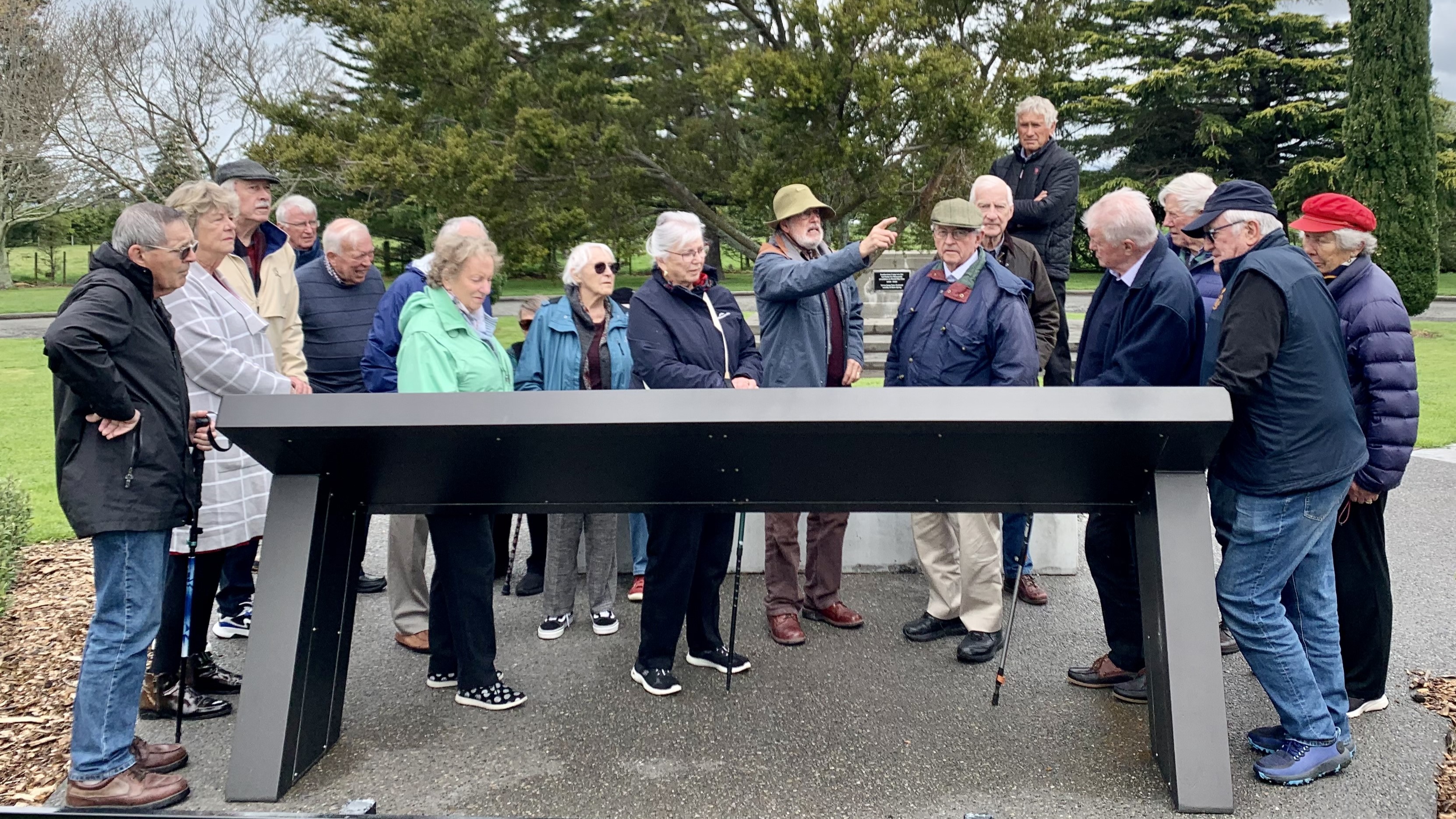
Neil Francis points out some of the features of the Featherston Military Camp from the memorial site.
The final stop was the ANZAC Hall in Featherston, which opened in 1916 as a recreation centre for the troops at the nearby Featherston military camp and still operates as a community hub. Suitably replenished with a picnic lunch, or what was left of it after several dips into it along the way, we headed up into the mist and back over the hill to Wellington. And so we said farewell to the Wairarapa and some of the hidden gems that abound in the region.
Our thanks to Pat and David Rutherford for organisation and local knowledge, and to Les Cockeram and Robin Corbett of TRANZIT for their attention to details and to our needs. Finally, thanks to the various hosts who made the whole trip worth while.
The book has been launched. It took months of research and writing, editing, design and printing and an anxious wait for the finished product to be shipped back from the printers in China, but it is now here.
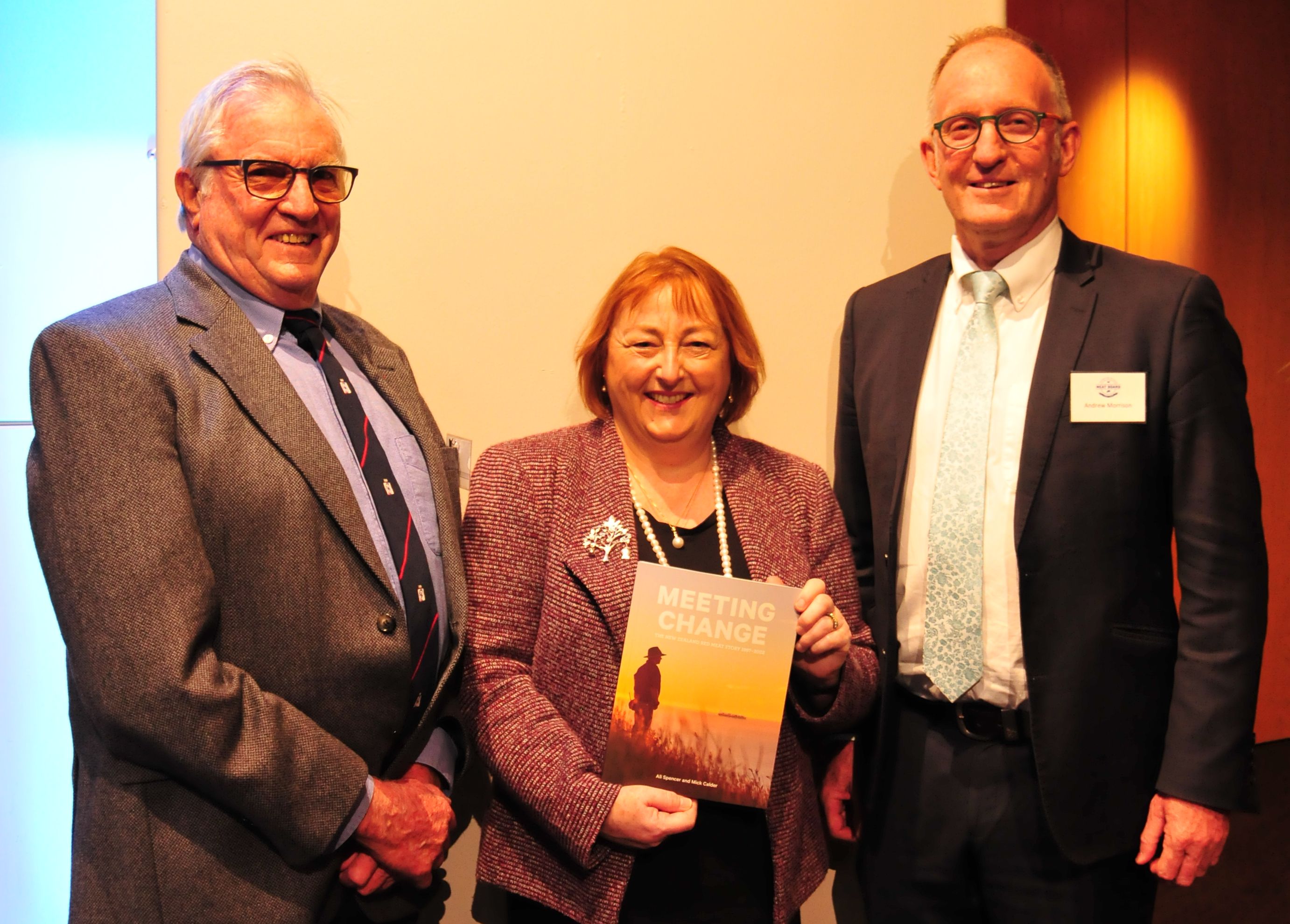
The launch took place at Te Papa Tongarewa, the Museum of New Zealand on Wednesday 29 June with an audience of current and former Board members and staff of the NZ Meat Board along with interviewees, meat industry personnel and Farmers Council members.
“The book makes for compelling reading and shows the many reasons New Zealanders have to celebrate our red meat sector,” NZ Meat Board and B+LNZ Ltd chair Andrew Morrison told the guests.
“Over the past 25 years, we have arguably seen more change than in the previous 75. No sector in New Zealand has had the productivity gains that the sheep and beef sector has achieved since the 1990s,” he noted, adding it is a book that will be of interest to everyday New Zealanders.
Good feedback has come from Peter Nuthall, Honorary Associate Professor Department of Land Management and Systems, Agribusiness and Commerce Faculty, Lincoln University, who wrote, “The book will become the bible for those wanting information over the period reviewed and while it probably won’t be a best-seller, it will be the ‘go-to’ book for those interested in analysing the past for very many years to come. It will live with pride in the archives of NZ.”
Also, a NZ Farmers Weekly review of the book noted: ““The highest export prices in history are helpful to farmers to commemorate the centenary of the New Zealand Meat Board in 2022. If they need a refresher course on how the meat industry arrived at such lofty heights, Meeting Change: the NZ Red Meat Story 1997-2022, written by Ali Spencer and Mick Calder, will suffice.” The book can be bought at meetingchange.nz. Note: Hardback copies have nearly sold out, but there are plenty of paperbacks.
Authors Mick Calder and Ali Spencer with NZ Meat Board Chair Andrew Morrison
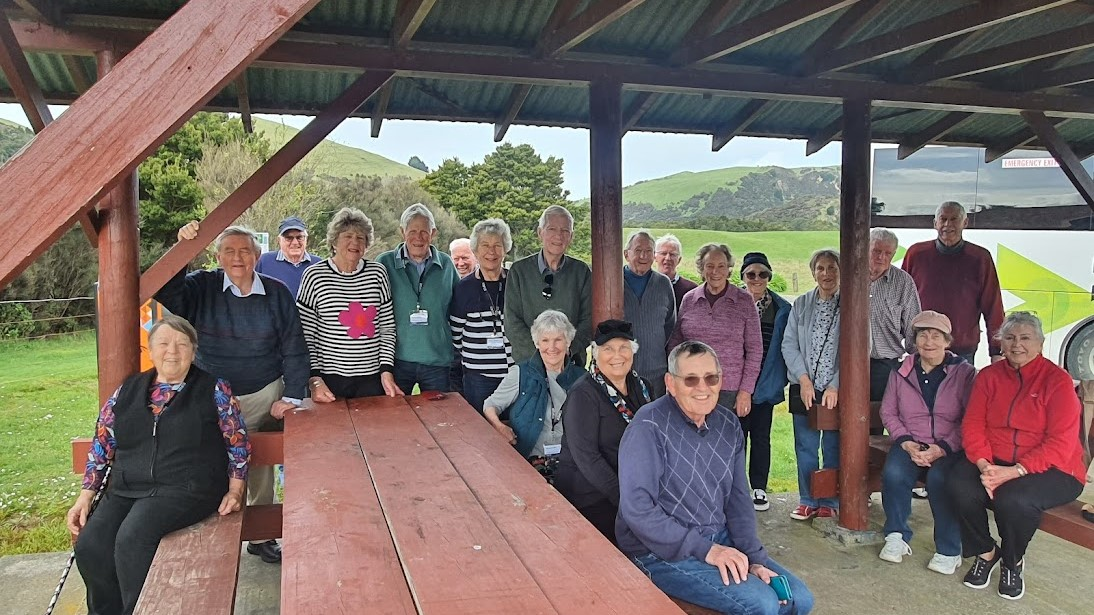
Seventeen intrepid travellers from the Wellington Central Probus club met our TRANZIT bus driver Les Cockeram at the Interislander terminal and prepared for a bit of a Cook Strait experience. We braved some horizontal rain, a delayed ferry departure due to strong southerly winds, and three to four metre swells in Cook Strait. This was the first leg of the trip to travel through Molesworth Station to admire the grandeur of the place while soaking up some of the history.
These were merely the opening bars in this comic opera. We were halfway across the Cook Strait when the Port Authority closed the port of Picton because wind gusts were too strong for ferries to berth, even with assistance from two tugs. So our ferry stooged around in Queen Charlotte Sound, doing the marine equivalent of an airline holding pattern by sailing up and down Queen Charlotte Sound. Originally this was to be for one or two circuits lasting just a couple of hours, but by the time the two ferries ahead of us had berthed and discharged we had done six circuits and the waiting time had stretched to eight hours. The usual three and a half hour journey took 13 hours!
Arriving at the hotel in Blenheim at 3.00 am meant we only had three and a half hours before setting out for Molesworth in our 4WD bus. The road through Molesworth is reasonably easy but our driver Rick Sterling was a fount of knowledge on the history of the station and the people involved, as well as having lots to tell about the surrounding countryside.
Molesworth Station, the government owned beef cattle station in the high country at the head of the Awatere Valley in Marlborough, covers 180,000 hectares which means it is bigger than Stewart Island. Māori had trekked through the region seeking new food supplies and routes to greenstone sources as attested by later discoveries of remnants of their encampments. Then European settlers investigated the region for stock routes from Nelson/Marlborough to Canterbury before it was opened up for extensive farming operations in the 1860s under leasehold from the Crown.
1Farming operations involved burning off the scrub including the dense growth of Matagouri or Wild Irishman (Discaria toumatou) and Spear Grass or Wild Spaniard (Aciphylla colensoi) to allow sheep and cattle to graze. But the sheep denuded the grassland with the assistance of an influx of rabbits.
In 1939 the leaseholders of five sheep and cattle runs finally decided they could not succeed against the ravages of diminishing income, rabbits, invasive weeds (Sweet Briar – Rosa rubiginosa and Tussock hawkweed – Hieracium lepidulum) ), and the harsh environment. The government took over four of the runs (initially the original Molesworth and Tarndale Runs , and later in 1949 the St Helen’s and Dillon Runs) to operate as one enterprise.
The Government forgave the various unpaid leasehold debts, installed Lands &Survey (now Landcorp) as manager, and set about a programme of recovery.
The new management plan specified cattle only, and the numbers were steadily built to a peak of 10,000 head. The rabbit problem was virtually eliminated, a controlled pasture renewal and grazing plan was introduced, and the financial position improved. A new approach to environmental (climate change) management has seen cattle numbers reduced to 6,000, but profitability maintained due to better management techniques.
We drove through the station on a beautifully fine calm day – a complete contrast from Day 1. Rick told us about the characters who took up the original leases as well as those who had lived and worked on the station, such as Bill Chisholm, the taciturn manager from 1942 to 1976. For lunch we picnicked at the cob cottage (the original homestead) at the northern entrance to the property. It was going to be a 65 km drive over the single lane shingle road from there to the “back gate”.
Some of the party were a little jaded after the previous long day but we stayed alert to enjoy the wide open spaces with very few cattle to be seen as they had been moved to summer grazing in the next valley. The road climbed over Ward Pass and down to the Acheron River and eventually to Acheron House.
This was an accommodation house for drovers and other travellers moving through from Marlborough /Nelson to the Canterbury and beyond. It had become run down and demolition was being considered but the Canterbury branch of the Historic Places Trust and Lands and Survey decided it should be saved and restored. Our day finished at Hanmer Springs with the delights of a cold beer before dinner and a dip in the hot pools to revive our spirits.
Day 3 was definitely devoted to 4WD country.
We travelled on SH 7 through the Lewis Pass for a morning tea stop at the start of the St James Walkway and on to Burnbrae, where we took the less travelled route north on a corrugated track through the dense beech forest with a few fords crossing the many creeks in the area.
The route took us lurching around tight bends and through numerous stream fords to climb over the Maruia Saddle and follow the Matakitaki River to Murchison for lunch. Then it was back “off-road” with slightly better conditions from the morning run, through the Mangles Valley and the Braeburn Track to Lake Rotoroa for a quick stop to see admire the scenery, gaze in awe at the eels under the jetty, and avoid the sandflies.
We finished our day at the Alpine Lodge in St Arnaud where some enjoyed a quiet walk in the beech forest down to view Lake Rotoiti.
The final day was almost an anti-climax as we merely investigated the source of the Buller River, assembled for a group photograph at Kerr’s Bay and then trundled down the Wairau Valley to Renwick and Spring Creek to Picton for the ferry trip back to Wellington.
The weather was perfectly fine, so the crossing kept to the schedule and we arrived in Wellington safe, sound and on time. A great time was had by all thanks to Pat Rutherford for her perfect organisation and to TRANZIT Tours and the magnificent driver Les. We will forgive them for the initial less than perfect ferry crossing.
A New Book to Celebrate New Zealand Meat Board Centenary
Mick Calder spent most of last year co-writing “Meeting Change – The New Zealand Red Meat Story 1997 – 2022” with long time meat industry colleague Ali Spencer. The book was commissioned by the Meat Board to celebrate its centenary concentrating on the past 25 years of change in one of the country’s significant export earning and employment sectors. This new book tells a fascinating tale of a period of complex and myriad changes within the Meat Board and its various industry good aliases, alongside the progressive reorganisation of the New Zealand meat industry production, processing and marketing operations.
There have been spectacular improvements in productivity, development of world leading farming practices through science and insights, cultural shifts and earning social licenses in the farming sector. The book also records the increasing collaboration between farming and processing groups, and shifting trade flows for New Zealand meat exports from west to east; all during a period of volatile political, cultural and economic change and uncertainty. The earlier history of the Meat Board has been recorded in “Golden Jubilee” edited by Dai Hayward which covers the first fifty years and “Meat Acts – The New Zealand meat industry 1972-1997” written by Mick Calder and Janet Tyson. Following on, this publication tells the story of the transformation of the statutory interventionist Board of the previous 75 years into a distinctly successful industry good organisation, Beef and Lamb New Zealand (B+LNZ), which provides numerous facilitating and advisory services to producers. The notable move to greater collaboration with other industry bodies has also been a marked feature of this era. Sheep numbers dropped precipitously from 45 million in 1997 to 26.8 million today as sheep and beef farms converted to dairying and life style blocks or were overtaken by the carbon priced attraction of forestry. But levy funded R&D promoted improvements in feeding, breeding and lambing performance to moderate the decline in production levels. The book reports on the efforts of many to restructure the industry to overcome the pressures of declining stock numbers, processing overcapacity as well as revisiting the clashes of perceptions, personalities and politics which torpedoed those conceptual and perhaps grandiose proposals. It similarly records demise of the Wool Board, the ill-fated merging of meat and wool activities and eventually the farmer decision to cease funding industry good activities. The free trade agreement with China opened up marketing options for an extensive range of meat products and by-products which allowed exporters to trade away from the more traditional markets and to secure improved prices.Chilled gourmet lamb and beef cuts, an increasing market for grass fed “natural” beef, and innovative processed products provided improving returns to both processors and producers. Red meat export earnings more than doubled and reached record levels in 2021. The 404-page book is fully indexed and includes well over 190 photographs, cartoons and illustrations. It will be published in June this year. Enquiries/orders http://www.meetingchange.nz Note to editors
“Meeting Change: the New Zealand red meat sector story 1997-2022”, Ali Spencer and Mick Calder. Published June 29, 2022.
Mary Egan Publishing. NZ Meat Board/B+LNZ Ltd
Pricing: Hardback $69.99 (ISBN: 978-0-473-60979-5), Softback $49.99 (ISBN: 978-0-473-60980-1) A 10% discount is available for orders received prior to the publication date.
Further information and distribution at https://meetingchange.nz. Contact: Ali Spencer ali@spencerpr.co.nz DDI: 021 344 286. Mick Calder mick.w.calder@gmail.com DDI: 021 438 941
I have been volunteering for Age Concern Wellington Region and was asked to comment on the negative connotations associated with the use of the collective noun “Elderly” when referring to senior citizens, older people etc. My opinion is set out below.
—————//————-
There is an ongoing debate about describing older people as a group. The trouble is that finding a word to refer to a very heterogeneous collection of citizens over the age of 65 years.
As soon as you start you run into the problem that just about any generic word can or could cause offense to either a single person or a sub-group of the population you seek to define. Ageism rears its head, along with all the other collective nouns in common use, but there are those who claim that the senior generation is not regarded as important as the other sectors of society.
When it comes to a crunch it is the collective word or words used that can cause many of the problems. The issue is that the word aims to define a group of people comprising some 15% of the population, aged between 65 and over 100. It includes any number of people with different abilities, interests, and levels of experience, living in a multitude of different circumstances – well off, to getting along as best they can.
Other groups like kids are more easily defined as they are lumped into smaller well-understood cohorts of pre-school, primary or secondary aged groups, without generally offending anyone.
But defining over 65-year-olds in a single group is a problem. It may be that the word chosen becomes over-used or associated with (real or imagined) negative aspects of the group and thus becomes unfashionable or unwanted. The current out of favour word is “elderly”. Does this phenomenon go in cycles?
That brings up my memory of a skit by stand-up comic Stan Freberg back in 1957 (I had to do a Google search to find the date). He was interrupted by a censor from the ‘citizens radio committee’ who objected when Freberg began to sing “Old Man River”.
The censor claimed, “The word “old” has a connotation that some of the more elderly people find distasteful. I would suggest you make the substitution.” So, Freberg changed it to “Elderly Man River”. The song went on with frequent interruptions from the censor. What goes around, comes around.
Now “elderly is out of favour and there is a whole lot of substitutes including ‘older people’, ‘seniors’ and the rather unfortunate ‘older adults’ which is a confusion, in its own right.
My question is whether it is the older generation who is worried about this or those who face the prospect of being stereotyped by an ageist collective name? I would hate to raise the issue of political correctness.
Admittedly, there are reasons some negative connotations such as the perceived cost to society due to superannuation and health charges, and there are seniors requiring support because they are isolated, disabled, become frail, or have mental issues. But this should not be regarded as being any different from other sections of society, — education, social welfare, unemployment, police, or corrections. It is all part of the cost of living in New Zealand.
And it might be said that getting to be older means these people have been through the mill, paid taxes, brought up kids in a proper manner (mostly) and probably done some pro bono work on the way.
Just like those other sections, there are organisations established to provide support and care for the less active older members of society. Age Concern Wellington Region provides a Visitor Service, Companion Walking Service, Pop-up Hubs for Seniors, Steady As You Go fitness and balance classes, as well as Staying Safe driving workshops and Tea & Tech classes to assist seniors in their daily lives.
Many of these organisations rely on the voluntary services of seniors who have experience and wisdom gained from a lifetime of getting on with it. So seniors could be regarded as contributing to, as well as depending on society and life in Aotearoa New Zealand.
From a personal point of view, I don’t really care what generic name I am saddled with. There is a view that ‘elderly’ is an offensive moniker for us oldies, silver tops, old farts, ancients, sages, or if you are an Aussie silver top campervan addict- SADs (See Australia and Die).
If you have been around as long as me and most of my mates you have been blamed, shamed, occasionally framed, and renamed. Basically, it is not something I lie awake at night worrying about.
I am of the opinion (and you can get opinionated when you have reached a certain age) that most of the venerable, revered, occasionally forgetful people do not give a tinker’s curse as to what the rest of humanity calls them. We have been there, seen and done that, bought the T shirt, acquired the cap, and possibly even kept a written record or diary retry about it.
There is more to life than worrying about a collective noun.


 WorkinWords