Probus Wellington Central Tour – September 2022
Wairarapa translates as “glistening waters”, which Māori legend/history advises can be explained in one of two, or maybe three ways. It is either the description of the sun shining on what is now lake Wairarapa as seen by a Haunui (the great-grandson of Kupe) when he reached the top of the Remutuka hills, or it is that the scenery he saw brought tears to his eyes as he scanned the new territory Or the tears were caused by his wife leaving him for a younger warrior. Lake Wairarapa is Ngā Whatu o te Ika a Māui (the eye of the fish of Māui).
The South Wairarapa coastline features some of New Zealand’s oldest inhabited sites, and local tradition states that the explorer Kupe lived there for a period. The southernmost point of the North Island, Cape Palliser, is known to Māori as Matitaki a Kupe, and other points along the coast also commemorate Polynesia’s most famed explorer. South Wairarapa District Council history
There are suggestions that the southern Wairarapa was first settled as a small Maori community from Palliser Bay moved north, due to an increasing population and diminishing food supplies of fish, shellfish, small birds and kumara. The main Māori tribal movements by Rangitane and then Ngati Kahungunu in the 1600s came in from the north.
Day 1. Wellington to Masterton
Whatever the story, “glistening waters” aptly applied to our departure from Wellington as rain accompanied us to the top of the Remutuka hill. Our Tranzit coach driver and tour guide was none other than Les Cockeram who led us on the memorable 13-hour ferry ride to start our Molesworth trip two years ago. An omen?
As luck would have it the sun shone while our party of 20 sat indoors and feasted on a sumptuous lunch at the Royal Hotel in Featherston, hosted by Theo Wisjmans and his crew. Unfortunately, the glistening waters returned as we arrived in Greytown for self-guided walks around the town centre. We had been warned that the shopping experience would probably not attract much interest from 50% of the group, but some retailers did provide seating for the men as they waited, but many of the shops close on Mondays so the shoppers had little to choose from. The fact that today was the anniversary of NZ women’s suffrage did not cut it with the retailers of Greytown.
Greytown is said to be the oldest town in the Wairarapa and the first planned inland town, with New Zealand’s most complete main street of wooden Victorian buildings. (Masterton was the second planned inland town). The idea was that the residents would have a house and section in town and travel to their allocated 40 acres of farmland each day. Unfortunately many chose to live on their farms so town sections were abandoned.
NZ history online records that, “Greytown was founded in 1854 by the Small Farms Association, which aimed to settle working people in towns and on the land. It was New Zealand’s first planned inland town, although the first settlers were greeted by dense bush. Once this was cleared, the town developed as a market and servicing centre.
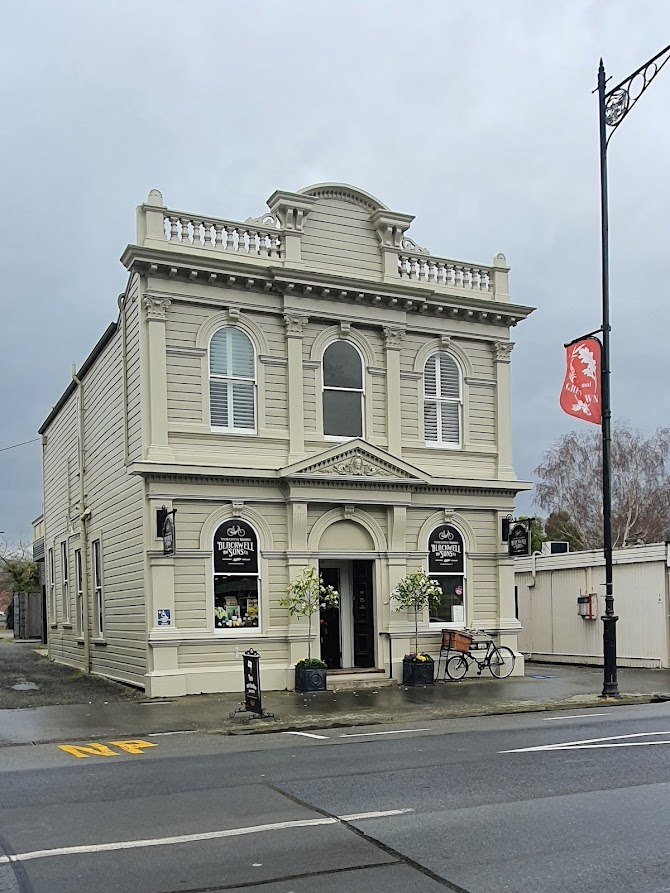
We wandered around in the light rain, absorbing the views of old wooden buildings, many of which were designed and built to look as though they were stone constructions, not only those such as the banks, but also the building that housed Blackwell and Sons Bicycle shop, forerunner to a bookshop ’empire’ with shops labelled Mr Blackwell’s, or Mrs Blackwell’s, bookshop. True to form there were seats for the men, but some were outdoors and tended to be damp.
After a short road tour around the outskirts of Greytown the trip continued through the lengthy strip development called Carterton and on to the Copthorne Solway Park hotel in Masterton, our accommodation and base for the next few days.
Following what seemed to be an extremely short break of 90 minutes the wine and food tour continued with a visit to Farriers Restaurant and Bar for another meal with country-sized portions. It was almost too much, but we managed to stay awake long enough to watch the preliminaries for the funeral of Queen Elizabeth II. That was no mean feat for us oldies.
Day 2. Rathkeale, Tui Brewery, and Waihi Waterfall
The day started with a quick flick through the highlights (if you can call them that) of the funeral service for QE II, and ceremonial transfer of the coffin to Windsor. There were sufficient replays to get the general gist of the ceremony, but it’s likely that more will be on offer.
We breakfasted at the ungodly hour of 7.30 which meant we had more time to review the funeral before our departure at 9.30.
Les took us on a tour of the back streets of Masterton to learn about the plethora of educational facilities available to the students of the Masterton area. There are numerous schools catering to the different social standings of the parents, and some of these institutions have remarkably small numbers of students. This was the lead up to venturing on to the hallowed grounds of Rathkeale College north of Masterton, which we circumnavigated with commentary from Part Rutherford who used to be the college registrar.
Rathkeale College was established in 1963 to complete the family of schools managed by the St Matthew’s Schools Trust Board, which already had a girls school in St Matthew’s Collegiate School and a preparatory school in Hadlow School. Source: Wikiwand
The more common commentary is that the school was established by the landed gentry of the Wairarapa to provide alternative educational facilities with a similar standard of education to that provided by Christ’s College or Wanganui Collegiate for their sons because demand exceeded supply at those renowned institutions. Both the original head and deputy headmasters came from Christ’s College. Nowadays, girls from senior classes at St Matthew’s in Masterton also attend. The buildings are set in immaculate tree-lined grounds in placid rural surroundings.
Our concern was whether the 335 pupils really appreciated their beautiful and peaceful setting, as well as the standard of education being provided.
Our tour of the hidden treasures of the Wairarapa continued north through Eketahuna, which is described as “a friendly rural town situated on the banks of the Makakahi River. Early pioneers originally named the town Mellemskov, which means “Heart of the Forest”. This name was eventually discarded in favour of ‘Eketahuna’, a Maori word which means to “run aground on a sandbank” (this name originated because Maori canoes could not paddle beyond this part of the Makakahi River).” Source: NZ History online
This quiet rural town’s main claim to fame, apart from being considered as the middle of nowhere, is that it is the home of the Tabu Adult Sex Shop.
The tour then became a beer, wine and food fest as we pressed on to the once bustling township of Mangatinoka, home of the famous Tui Brewery, which could not be classed as a hidden gem of the Wairarapa. Unfortunately, since being taken over by Heineken, almost all the beer is brewed in Auckland and the site is more of a monument to the glory days.
It celebrates its founder Henry Wagstaff, a failed cheese-maker and a bit of a philanderer, who stopped for a tea break on the banks of the Mangatainoka River and decided that while the water provided a fine cup of tea it would be better for brewing beer. The rest is history, helped along by the prominent tower (built without stairs to the top levels and the memorable Tui billboards. “I was just reading her T-shirt YEAH, RIGHT.”
Much against our better judgement we sampled the available beers, learned some of the history of Tui, dined on a BBQ lunch, and eventually departed, fully sated.
Heading east and north we entered hill country farming with a sprinkling of new season lambs plus the controversial development of extensive areas of farmland being sold to overseas investors and converted to pine forests for carbon credits. For some more traditional agriculturalists, it was a depressing sight. Some suggested that planting natives would be more acceptable, and we were reminded of the call for “the right tree in the right place”.
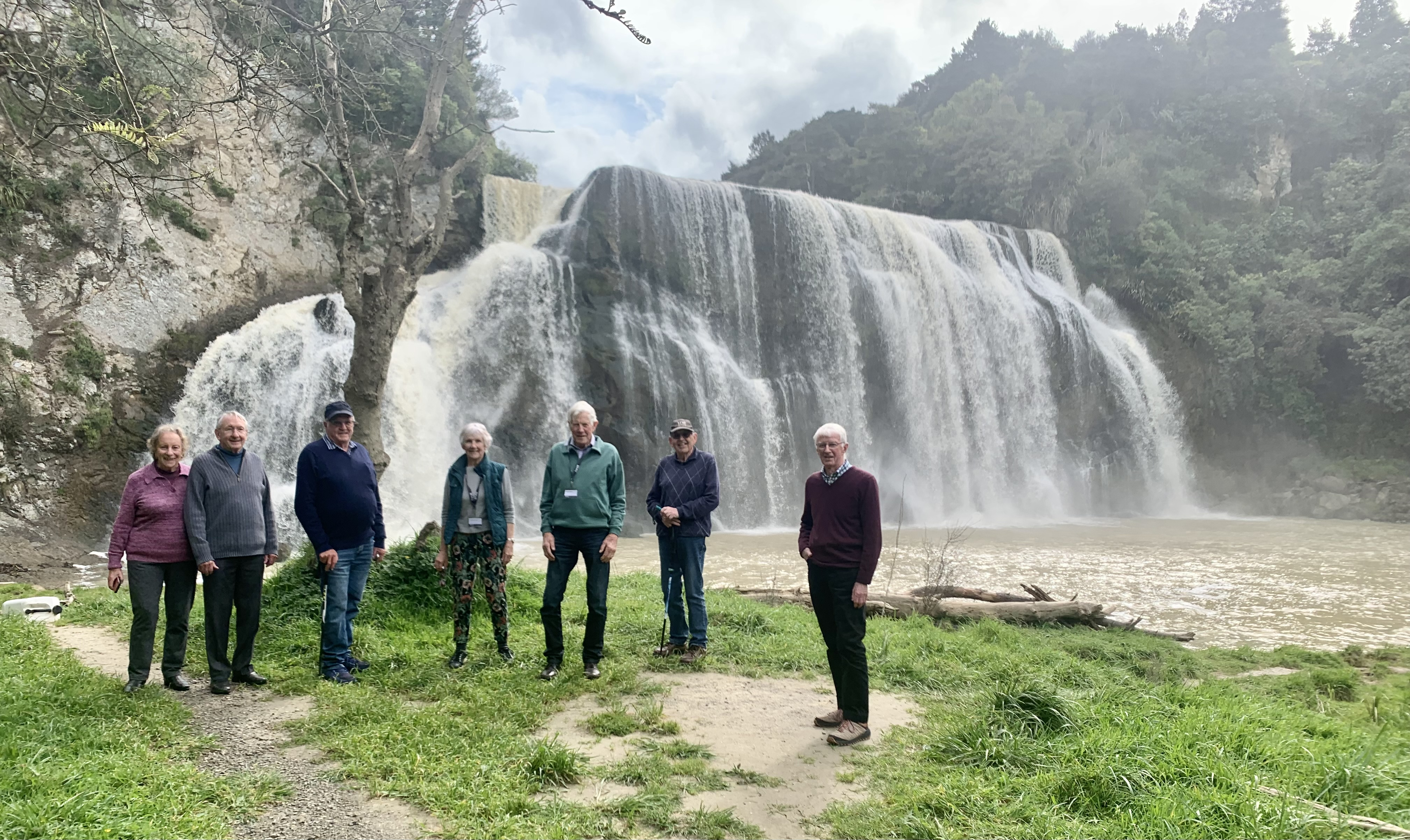
We wound our way through the scenic Makuri (white dog) gorge and eventually reached the Waihi falls – a cascade of water that is wider than it is high. Access for a better view was down a track and a series of 110 steps, attempted by those who thought their muscles and joints were sturdy enough. It was worth the effort.
The sun shone so we all assembled for a group photo which turned out to be a long session as Les had to operate several smartphones to capture the scene for members of the group.
Suitably photographed we headed to the Pongaroa Hotel for a reviving ale suitably accompanied by a little snack of pizza and chips. Recent rains in the area had caused a slip on our chosen road home required backtracking on our route through the Makuri Gorge, thus it was not surprising that several of our group succumbed to a quiet snooze. They needed to re-energise for drinks and dinner at the hotel to round out the day – and their body forms.
Day 3. Brancepeth and Te Parae and the “Gladdy”
As a reward for fortitude, we were granted a leisurely start this morning, except that for some of us breakfast at 8.00 am still fails to qualify as a leisurely start. The predicted rain had bucketed down overnight but stayed away for our departure.
Les, our driver and fount of all knowledge, decided to further improve our understanding of local lore with another tiki tour taking in the Masterton QE II Botanical Gardens, lake, and associated sporting facilities along with the indoor stadium. He advised the council had planned a convention centre, but an ongoing debate about where it would be sited has delayed its progress.
The object of today’s tour was to look and learn about the Beetham/Williams farming dynasty founded by the Beetham brothers, William, George, Charles and Richmond who, in 1856 took up a lease of 10,000 acres in the Wainuioru Valley 22 km east of Masterton. As a result of some hard work, a strategic marriage of daughter Ann Beetham to T C Williams of Te Parae (see below), and financial dealing they bought out the lease and expanded the united property to 70,000 acres running some 90,000 sheep plus cattle. The original 500 merino sheep suffered from foot-rot as well as the predations of feral dogs and pigs. The Beetham’s initial home was a whare or basic shed constructed in 1856 with pit sawn heart totara, then the original homestead was built in 1858, (still existing) before beginning a stately pile built in three stages from 1886 to 1905 et seq, complete with crenellated turret, lead-lined windows and 36 rooms. Shades of Little Britain perhaps.
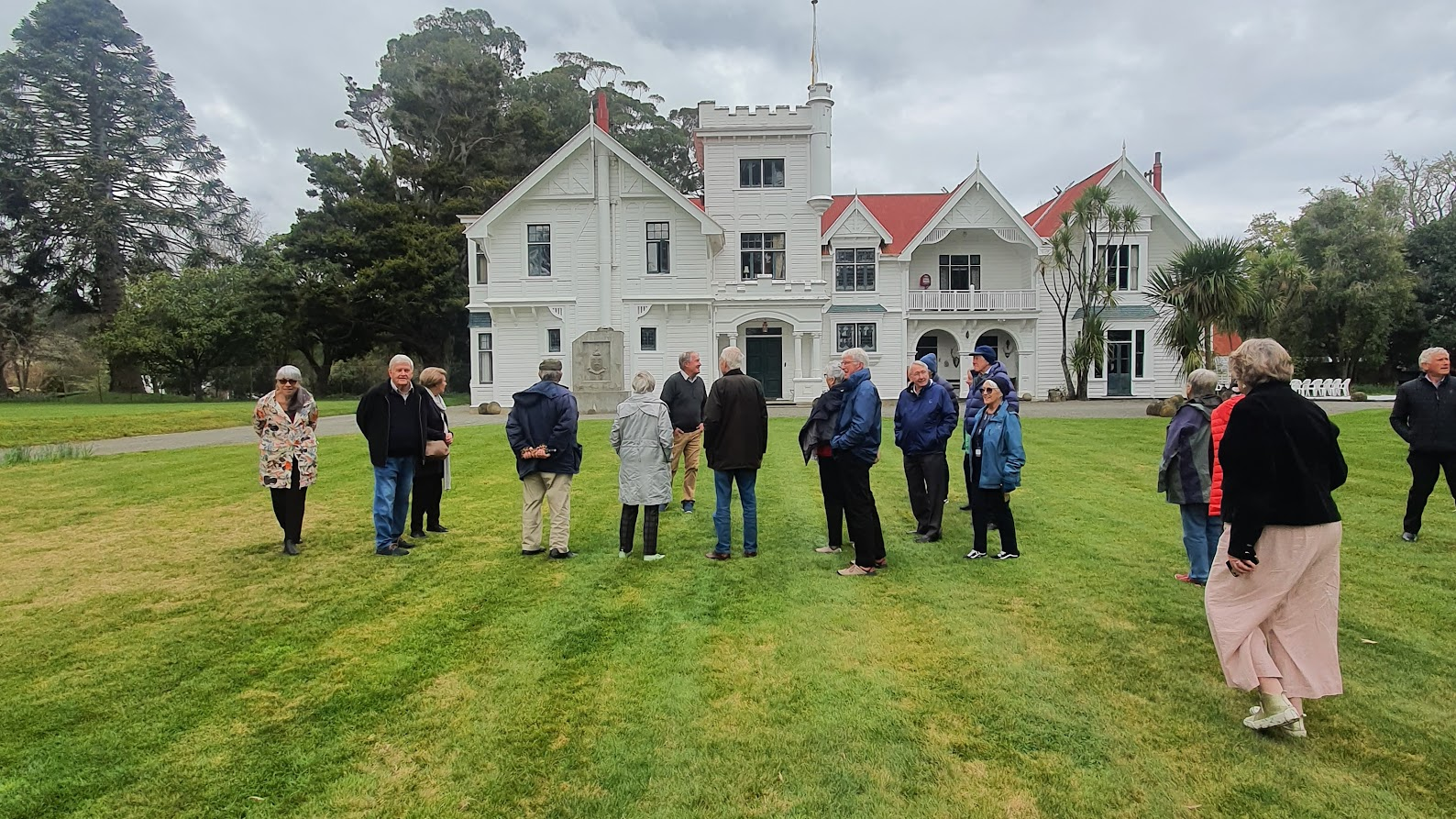
The immediate surroundings were planted with a variety of imported trees including English and Irish Yew, Araucaria bidwillii — commonly known as the bunya pine and sometimes referred to as the false monkey puzzle tree, peppermint gum, western red cedar, Oregon pine and several oak species.
But that was not all; given the size of the enterprise and the staff needed to keep it going there were numerous outbuildings such as stables, a 24-stand woolshed built in 1859, an acetylene gas production shed for the gas lighting, cookhouse, single men’s quarters, schoolhouse and library for the workers built in 1884, managers offices etc, as well as accommodation and other facilities at outstations around the station property. So it was more of a community than just a family home.
We were treated to morning tea/coffee and scones while being regaled by Ed Beetham with the history of the station and the trials, tribulations and triumphs of its owners and occupants.
The local history lesson was continued by Tom Williams at what remains of the Te Parae station after the combined Brancepeth/Te Parae enterprises were split up into eight separate properties due to the graduated tax introduced in 1906 to limit the size of these farming dynasties. Nowadays the Williams family has two farms – one of 2000 hectares and the homestead block of 400 hectares. The large house, overlooking the lake dug out using a horse-drawn scoop, is still occupied and used as a function centre for conferences. lunches and other celebratory events.
We were served a magnificent lunch prepared by Angela Williams with wine served by Tom who provided fascinating commentary on the property and its history.
Fully satisfied we then continued on to the historic Gladstone country pub (the “Gladdy”) for more food, wine and conversation to reflect on the day’s activities before heading back to Masterton to recover. The meal served up to us would have kept us going for three more dinners but we managed to restrain ourselves to only one serving of each course.
Day 4. Masterton to Wellington with history on the way
As if to signal that it was our final day breakfast was timed for the ungodly hour of 7.00 am so we were on the road by 8.30 with local historian Neil Francis providing the commentary on his speciality of the military history of the region. The first attraction was a quick tour of Solway Park A&P showgrounds which were used for an army camp tent camp plus buildings for officers’ mess during WW II. It was used as the base for the NZ Ruahine regiment from 1940 to 1942 and for the US Marine Corps Feb 1943 for R&R following the battle for Guadalcanal.
Heading east we passed by Hood Aerodrome established in 1929 by the Wairarapa aero club and named in memory of George Hood, who with John Moncrieff disappeared during their attempted, but ill-fated, first flight across the Tasman Sea in 1928. The aerodrome was expanded in1941 and used for training RNZAF No 14 fighter squadron using Harvards and P43 Kittyhawks before entering the war in the Pacific.
Close by was the Papawai marae, site of the Maori parliament in 1870. NZ History online comments, “Papawai has been home to Wairarapa Maori for hundreds of years, and in the late 1800s, it was the focus of Kotahitanga, the national Maori parliament movement. It’s still very much a community hub today.” Source: NZ History online
The interesting feature of the Marae is that it has carved figures surrounding the precinct, most of them are facing inwards with only four corner sentinels looking out. The explanation given is that iwi thought the main problems would come from within, not from pakeha without, so they needed to keep an eye on the occupants.
We stopped next in the main square at Martinborough which has three war memorials to the locals who did not return from the Boer War, and WW I and WW II, before moving on to Kahutara Memorial Hall, ex Soldiers Club building moved from Featherston military camp, for morning tea and a bikkie while we perused the photos and other memorabilia.
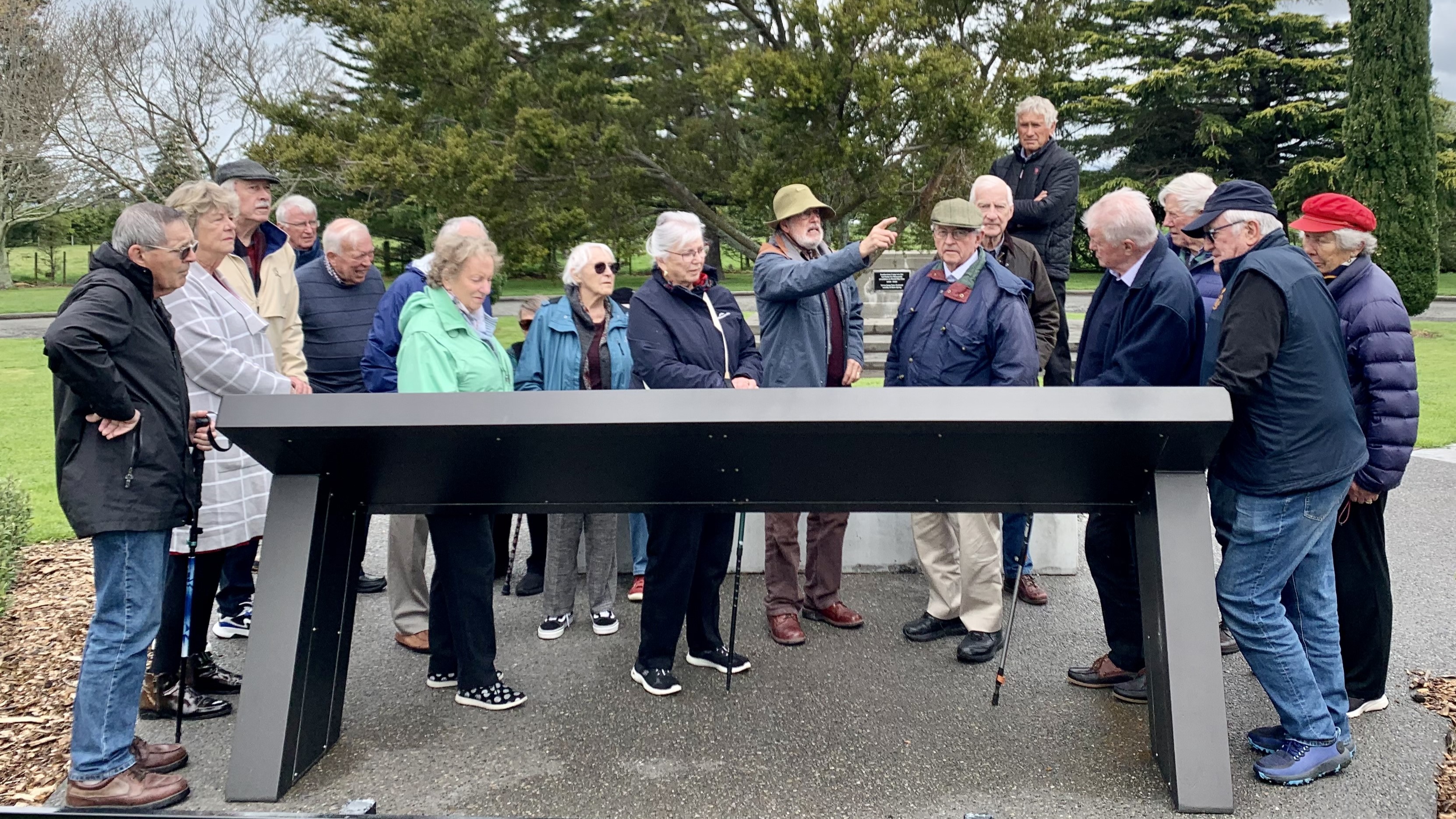
Back on State Highway 2 just north of Featherston is the memorial for the Featherston Military Campsite used during WW I and WW II Japanese POW memorial gardens. Our guide Neil Francis gave us a comprehensive commentary on the camp establishment and later break-up after the first World War and its subsequent development as a PoW camp for Japanese captured in the Pacific campaigns in the second War.
The highlight of the day was unintended. We ventured out onto a farm track to see the site of one of the firing ranges associated with the camp , only to have the bus more or less stuck in the mud from the recent rains. It took the efforts of Les with mats under the wheels, forward and backing manoeuvres and finally assistance — firstly a van and then a tractor to get our vehicle back on terra firma. Our group provided helpful comments along the way but these were generally superfluous.
The final stop was the ANZAC Hall in Featherston, which opened in 1916 as a recreation centre for the troops at the nearby Featherston military camp and still operates as a community hub. Suitably replenished with a picnic lunch, or what was left of it after several dips into it along the way, we headed up into the mist and back over the hill to Wellington. And so we said farewell to the Wairarapa and some of the hidden gems that abound in the region.
Our thanks to Pat and David Rutherford for organisation and local knowledge, and to Les Cockeram and Robin Corbett of TRANZIT for their attention to details and to our needs. Finally, thanks to the various hosts who made the whole trip worth while.

 WorkinWords