Archive for the ‘Meat Industry’ Category

“Meeting Change”


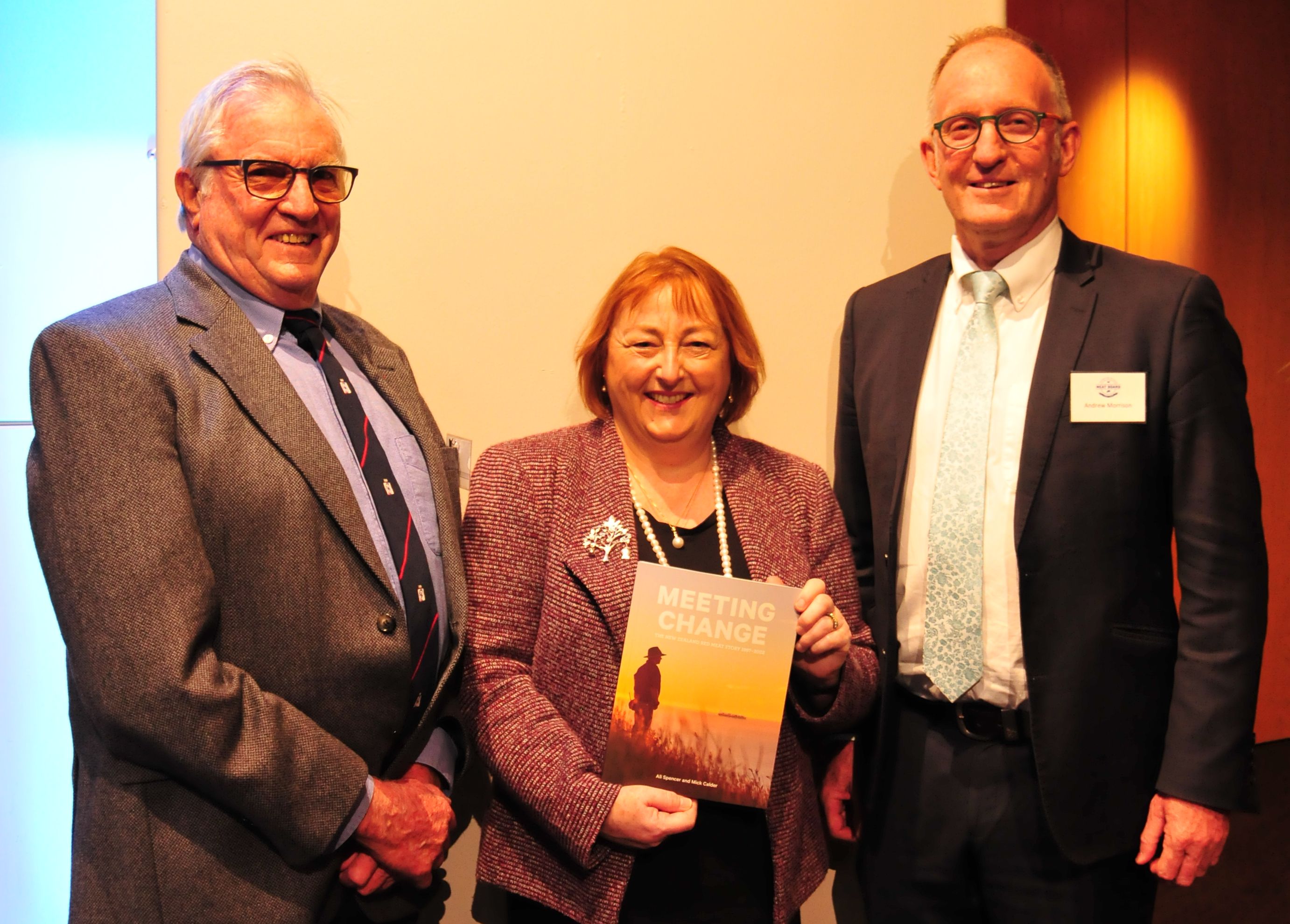
Meeting Change launched

The book has been launched. It took months of research and writing, editing, design and printing and an anxious wait for the finished product to be shipped back from the printers in China, but it is now here.

The launch took place at Te Papa Tongarewa, the Museum of New Zealand on Wednesday 29 June with an audience of current and former Board members and staff of the NZ Meat Board along with interviewees, meat industry personnel and Farmers Council members.

The book makes for compelling reading and shows the many reasons New Zealanders have to celebrate our red meat sector,” NZ Meat Board and B+LNZ Ltd chair Andrew Morrison told the guests.

“Over the past 25 years, we have arguably seen more change than in the previous 75. No sector in New Zealand has had the productivity gains that the sheep and beef sector has achieved since the 1990s,” he noted, adding it is a book that will be of interest to everyday New Zealanders.

Good feedback has come from Peter Nuthall, Honorary Associate Professor Department of Land Management and Systems, Agribusiness and Commerce Faculty, Lincoln University, who wrote, “The book will become the bible for those wanting information over the period reviewed and while it probably won’t be a best-seller, it will be the ‘go-to’ book for those interested in analysing the past for very many years to come. It will live with pride in the archives of NZ.”

Also, a NZ Farmers Weekly review of the book noted: ““The highest export prices in history are helpful to farmers to commemorate the centenary of the New Zealand Meat Board in 2022. If they need a refresher course on how the meat industry arrived at such lofty heights, Meeting Change: the NZ Red Meat Story 1997-2022, written by Ali Spencer and Mick Calder, will suffice.”
The book can be bought at meetingchange.nz. Note: Hardback copies have nearly sold out, but there are plenty of paperbacks.

Authors Mick Calder and Ali Spencer with NZ Meat Board Chair Andrew Morrison

MEETING CHANGE


A New Book to Celebrate New Zealand Meat Board Centenary


Mick Calder spent most of last year co-writing “Meeting Change – The New Zealand Red Meat Story 1997 – 2022” with long time meat industry colleague Ali Spencer. The book was
commissioned by the Meat Board to celebrate its centenary concentrating on the past 25 years of change in one of the country’s significant export earning and employment sectors.
This new book tells a fascinating tale of a period of complex and myriad changes within the Meat Board and its various industry good aliases, alongside the progressive reorganisation of the New Zealand meat industry production, processing and marketing operations.

There have been spectacular improvements in productivity, development of world leading farming practices through science and insights, cultural shifts and earning social licenses in the farming sector. The book also records the increasing collaboration between farming and processing groups, and shifting trade flows for New Zealand meat exports from west to east; all during a period of volatile political, cultural and economic change and uncertainty.
The earlier history of the Meat Board has been recorded in “Golden Jubilee” edited by Dai
Hayward which covers the first fifty years and “Meat Acts – The New Zealand meat industry 1972-1997” written by Mick Calder and Janet Tyson.
Following on, this publication tells the story of the transformation of the statutory interventionist Board of the previous 75 years into a distinctly successful industry good organisation, Beef and Lamb New Zealand (B+LNZ), which provides numerous facilitating and advisory services to producers. The notable move to greater collaboration with other industry bodies has also been a marked feature of this era.
Sheep numbers dropped precipitously from 45 million in 1997 to 26.8 million today as sheep and beef farms converted to dairying and life style blocks or were overtaken by the carbon priced attraction of forestry. But levy funded R&D promoted improvements in feeding, breeding and lambing performance to moderate the decline in production levels.
The book reports on the efforts of many to restructure the industry to overcome the pressures of declining stock numbers, processing overcapacity as well as revisiting the clashes of perceptions, personalities and politics which torpedoed those conceptual and perhaps grandiose proposals. It similarly records demise of the Wool Board, the ill-fated merging of meat and wool activities and eventually the farmer decision to cease funding industry good activities.
The free trade agreement with China opened up marketing options for an extensive range of meat products and by-products which allowed exporters to trade away from the more traditional markets and to secure improved prices.Chilled gourmet lamb and beef cuts, an increasing market for grass fed “natural” beef, and innovative processed products provided improving returns to both processors and producers. Red meat export earnings more than doubled and reached record levels in 2021.
The 404-page book is fully indexed and includes well over 190 photographs, cartoons and
illustrations. It will be published in June this year. Enquiries/orders http://www.meetingchange.nz
Note to editors

  1. “Meeting Change: the New Zealand red meat sector story 1997-2022”, Ali Spencer and
    Mick Calder. Published June 29, 2022.
  2. Mary Egan Publishing. NZ Meat Board/B+LNZ Ltd
  3. Pricing: Hardback $69.99 (ISBN: 978-0-473-60979-5), Softback $49.99 (ISBN: 978-0-473-60980-1) A 10% discount is available for orders received prior to the publication date.
  4. Further information and distribution at https://meetingchange.nz.
    Contact: Ali Spencer ali@spencerpr.co.nz DDI: 021 344 286.
    Mick Calder mick.w.calder@gmail.com DDI: 021 438 941
  5. A photo of the authors is available on request.

A bit of tongue (alternative protein) in cheek


Ever since the advent of burgers made from Textured Vegetable Protein (TVP) in the 1960s, and now with the hype being generated about alternative proteins, I have wondered why the creators feel the need to make their alternative protein product look and taste like meat. Are they secret meat eaters or are they genuinely interested in a protein substitute?

A recent report commissioned by Beef + Lamb New Zealand (B+LNZ) noted that consumers are looking for alternatives to red meat. Chief Executive Sam McIvor commented that “The technology to produce a consumer-ready alternative protein burger is here and is pushing for commercial scale.”

Archer Daniels Midland, the initial inventor of TVP (according to Wikipedia), developed his soy protein using an extruder to make the product in cylindrical form. The TVP was used as an additive or extender in the manufacture of food products; but then some users decided to make it into substitute hamburger patties, with similar colouring and texture to the original meat burger – but not quite the same. The current alternative protein developers are also reported to be aiming at producing alternative forms of ground beef burger patties and meatballs.

But if it is an alternative protein does it need to look and feel like meat? Is it to satisfy some primeval human desire to eat meat while lulling the senses to the fact that it is not the real thing?

If those who espouse the merits of the artificial product on environmental grounds, or even because of a personal distaste for the idea of red meat, then why does the substitute need to take on all or most of the attributes of the stuff they are trying to replace? The products are reported to have more protein, less fat and no cholesterol, which are claimed to be good for you. They also have less calories, so one would question why you would bother to eat it?

If it is so good, why not present it in the form of a log or biscuit, or cornflakes shapes, or even a yeast extract and develop recipes to match, rather than pushing it into the meat sector? It is a processed product so it could be produced in the same form as luncheon sausage slices and then it would look processed. Just think, the main course could be perfectly rounded protein biscuits or deli-style log slices with healthy vegetables, instead of medium rare steak and chips.

Of course, with all the claimed advantages of the alternative proteins, it raises the question of why the B+LNZ report also noted “an untapped demand for naturally raised, grass-fed, hormone-free and antibiotic-free red meat, with consumers prepared to pay a premium for such products”?

The other issue I have with alternative proteins is that they rely on the supply of soy beans and other such plants which will need to be produced in large quantities if the demand for alternative proteins increases. There are geographical and agricultural limits to the extent to which grassland used for grazing animals can be converted to productive arable land, so the prospects for alternative proteins taking out pastoral land are constrained.

Land available for increased production of such crops, over and above the current requirements, is limited unless more tropical rain forests are sacrificed, which implies large scale destruction, conversion, cultivation, additional fertiliser and herbicide use, and genetic modification of seeds, as is happening already in parts of South America and Africa.

So, are alternative proteins going to change the world, or are they just another flash in the pan?

Lost Sheep?


You might have been as surprised as I was to read that the national sheep flock has declined dramatically – again.
Statistics New Zealand’s Agricultural Production Survey 2016 indicates that the total sheep numbers in the country at 27.6 million, a drop of 1.5 million since June 2015. This brought forth all sorts of useless comparisons about the number of sheep per head of the human population. There was a time in the days of Supplementary Minimum Prices when there were 22 sheep for every human; the number is now about 6 – if that means anything.
More to the point the sheep numbers dropped by nearly 12 million head, or more than 30 per cent in the last decade. The agricultural production statistics indicate that the total sheep numbers at June 30 had plateaued at around 40 million head in the first five years of the 21st century; since then the rot set in.
There used to be some comfort taken in improvements in sheep and lamb productivity due to the combination of increasing lambing percentages and higher carcase weights, but even that movement has tapered off in recent years.
All of which leads to the depressing conclusion that the sheep meat processing and marketing sector face some hard decisions about further reductions in processing capacity or the whole system will spiral ever downwards and the lamb kill is going to come to a shuddering stop in the very near future.
And it is all very well announcing a breakthrough with new markets, new products or brands, but if the prospects for improving volumes are slim to non-existent, and the new venture can only proceed at the expense of reducing sales in established markets, then the breakthrough celebrations may have a bit of a hollow ring to them.
But maybe the reports on the sheepmeat industry should be less about the decline in the number of sheep per head of the human population and more about the effect on export earnings, and what if anything is being done to reverse this alarming trend. Where are the industry leaders with a strategy for the future growth in production, and more particularly improve returns to the producers.
The trouble is that there are few signs emanating from the various industry associations or the meat companies themselves encouraging sheep farmers to take action to reverse the declining trend. The industry gives the impression of acquiescence and/or resignation to the inevitable downward trend.
By the way, what has happened to the much heralded Red Meat Sector Strategy announced in 2011 by Beef & Lamb NZ and the Meat Industry Association? Its aim was “to identify ways in which the profitability of the red meat sector can be increased.” Three areas with the greatest potential to sustainably increase profitability were identified at the time of the strategy’s release, which were “in-market coordination, aligned procurement and sector best practice” but with the rather intriguing rider that the aim was to put “other long-held beliefs about known issues, including processor over-capacity and stock transport, into perspective.”
In the five years since the announcement there has been some progress with PGP projects for individual companies most of which aim at the production inside the farm gate and the processing side of the industry. The recently announced B+LNZ new market development strategy developing a red meat sector story targeting new and emerging markets is a move to address the activities in export markets. But there has been very little activity that might be construed as being the result of the strategic co-ordination of activities of all the players in the sector.
The decline in sheep numbers and production is attributed to the switch to dairying, the progenitors of which can be traced back to the late 1980s when the agricultural subsidies were removed and the spectre of overcapacity first loomed over the meat companies. However the splurge in centre pivot irrigation systems pushed up dairy conversions and numbers in the last 15 years, but even that trend has flattened out.
Such irrigation systems and the dairy milking facilities are expensive, so it seems that dairying was flavour of the month with bankers and investors with everyone jumping on the money-go-round. But dairy cow numbers have stuck at around 6.5 million for the last 5 years, which suggests that slump in prices and the slow recovery to the $6.00 per kg of milk solids may have dampened some of the euphoria. Bankers and investors can usually be regarded as fair weather friends.
If the NZ lamb export sector is to be revived perhaps the stakeholders should refer back to the words of their 2011 strategy regarding co-ordinated market behaviour. This advocated “Creating a strong brand position in premium markets”, and “Acting with scale through greater co-ordination of exports in target markets”. But it will need actions rather than words.

Update


After a long period of complete blogging indolence I have finally decided to get back to it. One of the reasons for my absence has been a shift back from the provinces to Wellington, with all the attendant issues and frustrations. More recently I have been involved in the editing and publishing of aa memoir written by a retired stock and station agent – see below.

All in a Day’s Work” A Wairarapa Stock Agent tells his Stories

John Griffith has been a stock agent for over 50 years his book recalls his interactions with the many farmers, livestock traders,occasional rogues and others operating in the livestock sector of the Wairarapa.

John Griffith is a gentleman, in the old sense of the word, and a stockman through and through. Handling and trading in livestock as well as riding, owning and training ponies and racehorses took pride of place in his life from an early age.

John grew up in a semi-rural environment in Masterton but hard times during the 1930s and 1940s saw him milking cows and delivering papers to generate income. His father Jack worked as a shepherd and a drover in the area and introduced John to the art of dealing with livestock as well as providing ponies for the family to groom and ride in the local competitions.

Living near, and occasionally working at, the Solway Showgrounds and Saleyards, John became infatuated with handling stock and the livestock auction system, which eventually led to his determination to become a stock and station agent.

The dream came true when he Joined his first stock and station company and he started his journey through various agencies learning the skills and lessons of his career choice.

John started work at a time when deals were made on the nod of the head, or by shaking hands, rather than written contracts. Personal integrity was part of the skill in developing good relations with the cohort of farmer clients necessary for success in the stock agency business.

Each time John moved to a different firm he took most of his clients with him, which meant he had a sound customer base when he went out on his own and established John Griffith & Co. Ltd.

John has handed the reins on to his son Johnny, and he now devotes his time to Probus and his continuing interest in racehorses at the Castlepoint and Masterton Racing Clubs. He is a Life Member of both these organisations. He has also devoted time to playing, coaching and administering rugby in the Wairarapa, principally with the Red Star Rugby Club of Masterton where he is also a Life Member.

John’s many friends, acquaintances and clients urged him to document his life and times, but it was the request from his eldest daughter jackie which spurred him into action.

ALL IN A DAY’S WORK is published by Mick Calder, WorkinWords, Wellington.

125 pages, over 100 photographs. Fully indexed.

Soft cover: NZ$ 35.00 (incl GST) plus P & P

Where has the heat and light gone?


There are occasions when commenting on the current state of the meat industry you might as well skim through one of the many recent company or industry histories. It is déjà vu all over again.

With just about any development or proposal you can flick through the history pages and find an instance to enable you to say that the industry has “been there, done that”.  And almost invariably the outcome was that unless it was something proposed or introduced by one or more meat companies it did not stick.  It has to be their idea; its part of their management style. So they haven’t got the T shirt.

So, much of the action from the Meat Industry Excellence group which generated a lot of heat and light in the media a few weeks ago has happened before (several times in the last 40 odd years) in both the meat and the wool industry.

And if history is anything to go by, the heat will cool and the light will grow dim, particularly if the saga drags on. There could be some marginal adjustments, so the stirrers can claim they had achieved some of the changes they were aiming for. In some instances the radical conservatives will weigh in and vote for the retention of the status quo.

Generally the causes for slow or no change have been either one, or a combination of the following: the inbuilt inertia of the current structure, the recognition by those advocating change that altering the established system is a daunting prospect, or farm gate prices begin to improve. As result the pressure for change diminishes, until the next time.

Those engaged in the industry have a vested interest in protecting their own organisation and their position in it, so any industry restructuring moves by the companies are likely to be marginal and slow. As economist John Kenneth Galbraith stated, “Faced with the choice between changing one’s mind and proving that there is no need to do so, almost everyone gets busy on the proof.” It is always easier to show that change is not really necessary.

There have been reports about four major meat companies discussing possible adjustments to improve the industry performance. It is likely that the deliberations are centred on possible collabaration relating to livestock supply and/or processing; after all they are production oriented managers. Marketing collaboration is usually left out in the cold, when it should be to the forefront.

But the resounding silence about the form, content or outcome of these discussions speaks volumes. It is difficult therefore to know whether they are making progress or just stalling for time. A cynic would suggest that if the meat companies can drag the discussions on long enough the new season will be upon them with attention swinging on to different and possibly more urgent issues.

The Meat Industry Excellence group has backed away from their original agenda for a united processing and marketing structure, and their stated aims now read like a wish list largely being left to the companies to implement, rather than an action plan.

Perhaps the MIE have discovered that changing a monolith is a tough ask. Some of the original aims might have required some form of regulation but there is little or no appetite for such interventionist activity these days, so it will have to be persuasion which takes time, and that is in short supply.

Looking at it from the outside there not a lot of urgency, and there is no inspirational or even evangelical leader standing up to lead the charge and beard the meat companies. So anything that happens is likely to be the result of a long winded process and the results could be minor and cosmetic.

To add to these woes some industry commentators are now talking about an improvement in prices for the coming season as a result of shortages from the drought and because of a drop in value of the NZ dollar. There are also suggestions of a lower lamb kill, so there are likely to be shortages in markets that have been diligently developed over the recent past. Will this put upward pressure on prices, again?

If this happens then the momentum for change that has been building will quickly and quietly dissipate. The meat companies will sail on their merry way and everything will be forgotten until next time; just as they have done several times in the past.

Collaboration continuum


This could be construed as shutting the stable door after the horse is five furlongs down the track but I have a couple of concerns about the “Collaboration for Sustainable Growth” (CSG) programme.

The programme received a symbolic seal of approval when farmers agreed in March that Beef & Lamb NZ could dip into reserve funds to contribute the producers’ share of the cost of the scheme.

The CSG is explained on the Beef and Lamb NZ website as follows: “A group of agribusinesses and the government have partnered up to invest in a collaborative programme to drive sustainable, long-terms profits for New Zealand’s red meat sector. All partners plan to work together to support the adoption of best practice behind the farm gate, and between the farm and processor.”

My concerns are that in order to achieve “long term profits for the red meat sector” all of the emphasis is on the producer end of the supply chain. The focus for improvement in productivity is still behind the farm gate with the presumption that farmers have been neglecting their duty to drive for profits in the red meat sector.

For my money, the farmers have done an amazing job of improving on-farm productivity and keeping the red meat sector going in the face of fluctuating weather conditions, inconsistent prices and returns, unfavourable exchange rates, opportunist selling activities, and pressure from bankers and other advisors to convert to dairying or some other capital intensive pursuit. The inconsistency in wool returns and the demise of wool promotion and R&D have not helped, but that is another story.

Despite these adverse conditions, the productivity of the average sheep and beef farm has continued to improve, as shown by the 83% increase in the weight of lamb produced per ewe over the last 20 years. Admittedly sheep numbers have declined but that cannot be entirely related to unproductive farming practices.

In order to achieve the continuous increase in productivity, and despite the fact that they are all operating in a competitive environment, farmers have been quietly collaborating and sharing information on most aspects of best practice behind the farm gate.

Back in the day (as the saying goes these days) the Department of Agriculture used to employ sheep, wool and beef advisors to keep farmers up to date with developments in science and technology that would assist in improving productivity. In this age of self help and private enterprise these officers have gone the way of most MPI services.

Farmers have relied on their own resources, farm discussion groups, field days and just plain sharing of information, which has continued with or without assistance from government agencies. Beef & Lamb NZ have been contributing as part of their farmer funded activities, using current income derived from levies, but now they are going to dip into the reserves.

In essence the farmers have been getting on with information gathering and sharing to maintain a steady improvement in productivity for the past twenty years.

But now the various meat companies and agribusiness groups associated with the PGP schemes have the temerity to propose that farmers spend some of their reserve fund, via B&LNZ, to encourage them to continue to get together to collaborate and share information to keep improving their productivity. It is as if the farmers are the root cause of the problems of the industry.

When did the meat companies or the banks last get together and share information to improve productivity? Will they be using reserve funds or current income to fund their contributions to the CSG?

The outstanding feature of the various PGP projects that have been announced so far is that they have been proposed by individual companies, and there is a strong hint that any benefits derived will be held fairly close to the chest of the company at the centre of the particular scheme. The idea of information sharing to improve the productivity of the processing and marketing sectors is an anathema to them. Collaboration among processing companies has never been their strong suit.

While the four major meat companies claim they have been meeting to discuss possible structural changes for the future meat industry there is little evidence so far of them sharing any of this information with the other stakeholders involved – the farmers.

Farmers react to incentives and the best one is consistent pricing. Not the run away boom followed by three years of austerity while the companies and the banks recover from their excesses. So maybe there should be a move to encourage the companies to collaborate to improve their market intelligence and marketing efficiency.

P.S. I have deliberately ignored the word ‘sustainable’ since I consider it is just another multi-syllable word that has become fashionable, and can mean what I say that it means.

Are we better than Oz?


After ranting on about the need for a more collaborative approach to the marketing of NZ meat exports it is refreshing to be told that our marketing efforts are streets ahead of the Australians.
I am in Australia for a couple of weeks and quickly became aware of the impact of extremely dry conditions, a high dollar and the drop in export market prices from the heady levels recorded last year, which was having a devestating effect, both in terms of morale and financial returns rural Australia.
But the difference was the advice from a prominent Aussie beef and sheep farmer that Kiwis were doing so much better than the Aussies; in particular the bilateral trade agreements easing access into Asia, and our marketing organisation.
The comment rgarding marketing was a bit of a surprise to me and I immediately countered with the view that our meat was generally sold rather than marketed. However the main focus of the comment on our marketing was related to the impact of Fonterra in intenational markets, but then the operations of the Lamb Company in North America were also touched upon.
A natural reaction would be to bask in the glow of these laudatory comments, but I had to remind my host that we were a long way from an efficient marketing operation for the majority of our sheep and beef markets.
As I am biassed I advised that sorting out the marketing should be the priority for the NZ meat industry and could be achieved given that the collaborative models are already available. Any ideas of improving collaboration in the procurement and processing sector, whether it be by mergers or even Tradeable Killing Rights or any other consultants’ proposal, would be a hard commercial slog to ovecome the ownership and cultural differences.
Still, it is encouraging to think that the Aussies consider are better than them at something.

Its all about marketing


One of the Strategic Themes of the Red Meat Sector Strategy (RMSS) was a call for ‘Increased co-ordinated in-market behaviour’. For all the puffery surrounding the strategy an ordinary bloke like me, sitting in the provinces, would be at a loss to discover any increase in co-ordination in the markets for red meat.

All I could find was a Quarter 4 2011 report released in October 2011; where is the 2012 report?

That report notes an increase in co-funding by processor partners in the Meat Promotion Group, but the Group was in existence prior to the RMSS, so it was hardly a new co-ordination initiative.

There is the NZTE Red Meat Sector Market Development Contestable Fund which is designed ‘to encourage market development projects that lead to profitable and sustainable growth for the NZ Meat Industry’, with projects that can have a transformational impact for the wider red meat sector. But they are individual initiatives, rather then co-ordinated approaches. So one is led to conclude that the co-ordination of in-market behaviour is just plodding along.

It should be recognised that the RMSS report described the ‘Marketers’ as being predominantly within processor companies and had the following characteristics:
They are often only a small team,
They undertake very little investment in marketing and market development activities, and
They share some common customers in key markets.
This description raises the question as to why there has not been a greater focus on the marketing activities, rather than forever trying to wrest better returns from improving productivity of already stretched producers, or from processor mergers, closures and restructuring.

Looking at the developments in the fortunes of other sectors of the primary sector the one major difference is there is a distinct lack of marketing co-ordination or co-operation in the sheep and beef sector. Its all about marketing, not only for the red meat sector but also for wool.

At the risk of being labelled a ‘market socialist’ I would suggest that as the red meat industry is predominated by two co-operatives maybe attention should be focussed on the advantages of the formation of a marketing co-operative. It may even be possible to persuade some of the privately owned companies to participate.

If you are looking for guidance on the pros and cons of marketing co-operatives then the best place to look is that hotbed of capitalism – the USA – where co-operative agricultural marketing organisations flourish. However the Danes, Dutch, German and French are also avid supporters of co-operative corporations; not just in the form of farmer owned organisations, but centralised co-operatives undertaking marketing and other services for its regional or smaller member co-operatives. NZ has its marketing co-operatives in the form of Fonterra and Zespri.

The benefits of co-operative marketing are generally recognised:

Economies of Scale – the economies of joining forces with the consequent reduction in costs, and marketing under a strong brand;

Marketing expertise – a larger co-operative marketing organisation enables processors with predominantly production skills to engage marketing managers with the expertise to develop profitable market channels and brands;

Bargaining power – the establishment of a larger group provides a greater degree of market power in dealing with customers and probably other service providers such as transport companies and even bankers;

Flow of Product – a joint marketing organisation would assist in meeting the requirement from retail customers these days for a consistent flow of product despite adverse events, droughts or floods or even seasonal volatility which disrupt that flow;
Product returns – the net income generated by the marketing organisation is returned to the members in proportion to the volume of product supplied adjusted to take account of different product formats.

There can of course be some challenges such as agreeing on a common mission and recognising that there has to be some give and take between the processor members and the marketing organisation so that one does not predominate. As directors of the marketing co-operative are invariably representatives of the processor members they should be reminded they are there to work for the good of the marketer not the directors’ own companies.

The biggest challenge however is to develop trust in the other members particularly with respect to sharing of information relating to both processing/production issues and market intelligence. Such trust is essential to ensure that the members remain loyal to the organisation and do not try top circumvent it for their own advantage.

I am an advocate for the co-operative marketing model because I have seen it working well. The New Zealand Lamb Company was established to market lamb in North America, and had a volatile history, but in the late 1990s it was restructured along co-operative marketing lines. Despite some issues with declining supplies from NZ and changing membership due to the restructuring of the industry here, the co-operative organisation has thrived and produce reasonable returns for its members.

So the model exists and I reckon it would be worth considering either a co-operative marketer for other key export markets or even a central buying and marketing organisation for all markets. But that may be too close to the NZ Power proposal.

Consolidation in the Meat Industry


A few years ago I came across a couple of reports about the consolidation of the US meat packing industry. The usual 80:20 rule applied in the beef industry – four firms handled 80% of the beef slaughter.

The focus was on beef, pork and poultry and the report had little if anything to say about lamb. But it got me thinking about the NZ meat industry, so I wrote an article about it and recently I reviewed what I had written to see if anything had changed over the years.

Four multi-plant operators; Affco, Alliance, ANZCO and Silver Fern Farms – still dominate the NZ lamb industry, with Ovation running close behind. According to recent data released regarding the 2012 allocation of the EU quota they handle about 75% of the lamb going to the EU. The actual numbers of stock processed by each company is commercially sensitive information, so there no figures for total sheep and cattle slaughter, but it is likely that the 80:20 rule applies.

Each of these major companies have been involved in what has been euphemistically termed the “rationalisation” process over the last 30 years, with closures, mergers and consolidation being the prevalent activity, presumably with the aim of matching the processing capacity to the numbers of stock available.

This might lead to the conclusion that the industry has achieved that much heralded nirvana promoted by Charles Hilgendorf and Adam Begg of the Meat Board, and Waitaki’s John Neilson, in the 1970s and 1980s.

They advocated the development of four large NZ owned companies plus some niche operators; this is close to a model structure being promoted by some of the speakers at the recent MIEC roadshow, although the MIEC preference is for one farmer owned company controlling some 80% of the business.

But a quick bit of research shows that after all the rationalisation, restructuring, changes in ownership, company crashes, plant closures and reconfigurations in the last 30 years, the number of plants has not changed significantly. Only the names of the companies have changed with Richmond disappearing and ANZCO joining the ranks ot the top four.

According to Beef and Lamb New Zealand there were 56 licensed meat export plants in 2012; this is 4 more than in 2000 and equal to the number in 1990; so despite all the consolidation activity the numbers remain the same. The only difference is the increase in the number of plants processing beef (there are now 37 handling beef either alone or in a multi-species operation), reflecting the change in livestock numbers and the increase in culled dairy stock.

So while the NZ processing industry might be seen as following the same path as the USA, there has been little change in the degree of consolidation over the years. While the bigger companies rationalised plants to achieve economies of scale, other entrepreneurs continue building capacity with smaller plants.

The USA reports noted that with the emphasis on cattle feed-lotting, “hog” farms and larger production units, it was economic to establish large slaughter units close to the production source. Also changes in plant technology had improved scale economies, and there had been some vertical integration of slaughter, further processing and packaging activities.

The variable NZ geography, a wider spread of livestock production, high transport costs and little use of feedlotting means that the clustering effect with larger scale processing plants is less likely here. However further processing and packaging has developed apace with an increase in the proportion of cuts and the greater emphasis on chilled product.

One of the concerns that the USA report considered was that consolidation led to reduced competition. The reports pointed out that fewer operators raised the possibility of lower prices paid to livestock producers, and for increased prices to retailers and consumers.

While the possibility of reduced competition for livestock exists here in NZ with four large operators, the tendency for new small plants to proliferate is likely to provide producers with a reasonable level of competition for their stock.

So the processing sector may have been rationalised to gain efficiencies but the penchant for having small operators to keep the big players honest still prevails. Any suggestion of further consolidation is likely to result more small processing operations to fill in the gap, or to “keep the buggers honest”; a case of deja vu all over again.

And the export and selling side is as fragmented as ever.

From a chauvinistic Kiwi stance, we should aim for the best possible returns from the overseas markets. We should have a structure to ramp up prices or at least provide the NZ meat export sector with some market power, as can be seen in the dairy industry.

The reality in meat export marketing is a little different. At the latest count there were 123 licensed meat exporters – this is well down on the 263 registered exporters more than ten years ago, but you still have to wonder what they all do.

While some may be specialising in selected products or markets, many will be competing to sell similar products to a limited number of buyers in our major markets, with price being the only real variable in the equation.

Maybe it is time to look at different structures to provide that market power. Watch this space.